Steel Performance Testing: Hardness, Strength, and Toughness
Dec 18th 2025
Steel is the backbone of knives, aerospace components, and countless industrial tools. But how do manufacturers know if the steel will perform as expected? The answer lies in steel performance testing. By measuring properties such as hardness, strength, and toughness, experts can determine if a steel is ready for demanding real-world applications.
At Niagara Specialty Metals, these tests ensure that every sheet, plate, and custom alloy meets the highest standards before reaching the customer.
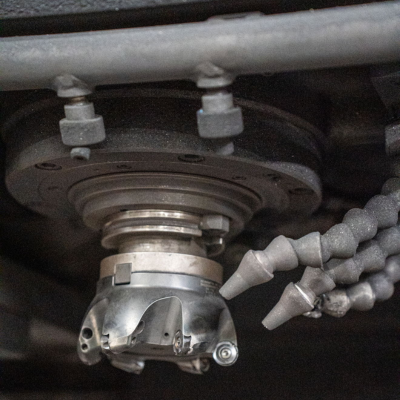
Hardness Testing: Measuring Resistance to Indentation
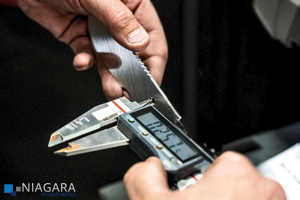
Hardness is often one of the first things customers ask about. It measures how resistant the steel is to indentation or penetration.
In a Rockwell hardness test, a ball or diamond tip is pressed into the steel with a specific force. The depth or size of the indentation determines the hardness value.
- Rockwell 40 HRC is considered relatively soft.
- Rockwell 60–65 HRC is very hard, typical for premium knives.
Carl Stroud, National Sales Manager at Niagara Specialty Metals explained it simply: “The deeper the ball presses, the softer the steel. A shallow impression means higher hardness. This test is critical because hardness directly affects edge retention, wear resistance, and the ability of a blade or tool to perform under stress.”
Strength Testing: Pulling Steel Until It Breaks
Steel strength is measured through tensile testing. A sample shaped like a “dog bone” is gripped on both ends and pulled until it fractures. The machine records how much force is required to stretch and ultimately break the steel.
This test also reveals the material’s ductility, how much it stretches before breaking, and the reduction in area, or how much thinner the steel became under stress.
As Carl noted, “the process can be dramatic. When a steel bar finally snaps, it can sound like a shotgun blast.” The test proves whether a steel can handle the expected loads in aerospace structures, knives, or industrial machinery.
Toughness Testing: Absorbing Energy Without Breaking
While strength shows how much force a steel can take, toughness reveals how much energy it can absorb before failure.
One of the most common methods is the Charpy impact test. A small notched steel sample is struck by a swinging pendulum. The machine measures how much energy the sample absorbs before breaking at the notch.
- A brittle steel absorbs little energy and breaks easily.
- A tough steel absorbs more energy and resists sudden fractures.
For knife makers, toughness determines whether a blade chips during chopping. For aerospace, it ensures components survive repeated stress cycles, like landing gear hitting the runway day after day.
Why Steel Performance Testing Matters
Without testing, manufacturers would have no reliable way to predict performance. Each test provides a piece of the puzzle:
- Hardness indicates wear resistance and edge retention.
- Strength shows how much force the steel can withstand.
- Toughness ensures durability under impact and repeated stress.
Together, these tests give a complete picture of how steel will behave in real-world applications.
Conclusion: Reliable Steel Starts with Testing
Steel performance testing is more than a laboratory exercise, it’s the foundation of quality and trust. By carefully measuring hardness, strength, and toughness, Niagara Specialty Metals ensures that every alloy performs as expected, whether in a chef’s knife, a jet engine, or an industrial tool.
Customers can be confident that the steel they purchase has been tested, validated, and engineered for success.
Looking to learn more about steel performance testing? Check out some of our related blogs here:
Steel Toughness Vs. Strength - What's the Difference?
High-Performance Knife Steel Explained
For more information, check out our other blogs.
Click here to view our product catalog at our updated e-commerce store!
Interested in additional information on knife steel or CPM® MagnaCut stainless steels? Click here!