

CPM® 154CM PM Knife Steel
Industries: Cutlery & Knives
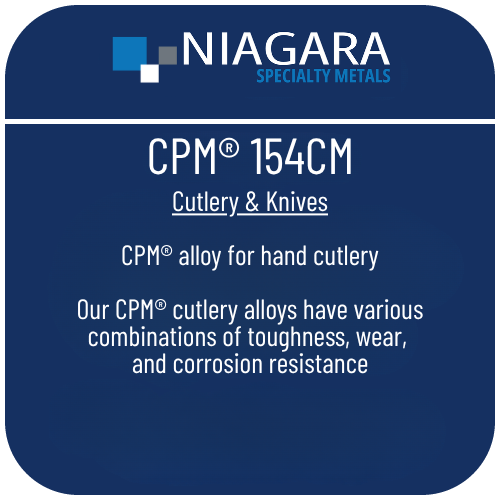
- CPM® alloy for hand cutlery
- Our CPM® cutlery alloys have various combinations of toughness, wear, and corrosion resistance
- Manufactured in the USA
For a data sheet on CPM® 154CM PM Knife Steel, please click here
Tolerance and Finish
Material is sandblasted to a gray matte finish.
The thickness and width are supplied oversize to finish at the requested dimension.
Cutting Methods
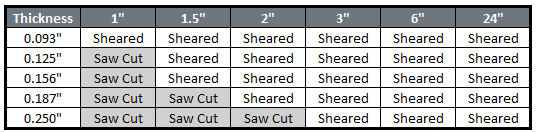
All orders will be sheared to size unless the width is too narrow.
$100 minimum per order please.
All dimensions are in inches.
The length can range from 35-1/2 to 38 inches.
The width for 24" sheets can range from 23 to 25 inches.
CPM® 154CM PM knife steel provides balanced toughness, corrosion resistance, and wear performance for premium knife manufacturing.
Hot rolled & processed by the employee owners of Niagara Specialty Metals in Akron NY
- Take a virtual tour of Niagara Specialty Metals. Click here to watch the full plant tour on YouTube.
- Learn more about our Specialty Metals for Cutlery and Knives. Click here to explore the full range of knife steels we supply.
Cut Method by Thickness / Width
| Surface Finish | Descaled |
|---|---|
| Width | 1", 1.5", 2", 3", 6", 24" |
| Thickness: .103/.113 thick will finish at | .093" thick |
| Thickness: .140/.156 thick will finish at | .125” thick |
| Thickness: .172/.188 thick will finish at | .156” thick |
| Thickness: .207/.227 thick will finish at | .187” thick |
| Thickness: .275/.300 thick will finish at | .250” thick |
| Length can range from | 35 1/2" to 38" |
CPM® 154CM PM Knife Steel Data Sheet
Typical Composition
| C | Cr | Mo |
|---|---|---|
| 1.05 | 14.00 | 4.00 |
CPM® 154CM is the CPM® manufactured version of the standard 154–CM. The CPM® manufacturing process produces a uniform distribution of the carbides in this grade, giving this CPM® 154CM easier grinding and polishing, plus better toughness, than conventional 154–CM, while retaining similar heat treat response and wear properties. CPM® 154CM offers better corrosion resistance, better wear resistance and better hot hardness than 440C ESR, plus higher toughness. For knifemakers, it offers better edge retention and chipping resistance than 440C ESR.
The CPM® process produces very homogenous, high–quality steel characterized by superior dimensional stability, grindability, and toughness compared to steels produced by conventional processes.
Typical Applications: Cutlery, bearings, and corrosion resistant tooling.
Machinability: Because of the CPM® processing, CPM® 154CM is easier to machine and grind than standard 154–CM. General machining parameters are similar to 154–CM and 440C ESR.
Mechanical Properties
| Grade | Hardness (HRC) | Wear Resistance | Total Carbide Volume |
|---|---|---|---|
| 154-CM | 58.5 | 49 mg | 17.5% |
| 440C ESR | 57.5 | 66 mg, 55 mg | 12% |
*Wear resistance measured by the pin abrasion method. Lower number (mg.) is a lower weight loss (in mg) and therefore better wear resistance.
Hot Hardness
| Heat Treatment | Initial HRC | HRC Test at: 400°F | HRC Test at: 500°F | HRC Test at: 600°F | Final HRC |
|---|---|---|---|---|---|
| A | 62 | 59 | 58 | 55 | 60 |
| B | 62 | 55 | 62 | ||
| C | 64 | 57 | 64 |
Thermal Treatments
Annealing: Heat to 1650°F (900°C), hold 2 hours, slow cool no faster than 25°F (15°C) per hour to 1200°F (650°C), then furnace cool or cool in still air to room temperature. CPM® 154CM can be cycle annealed by heating to 1600°F (900°C), hold 2 hours, cool to 1300°F (704°C), hold 4 hours, then air cool.
Annealed Hardness: About BHN 235.
Stress Relieving
Annealed Parts: Heat to 1100–1300°F (595–705°C), hold 2 hours, then furnace cool or cool in still air.
Hardened Parts: Heat to 25–50°F (15–30°C) below the original tempering temperature, hold 2 hours, then furnace cool or cool in still air.
Hardening
Preheat: Heat to 1400°F (760°C) Equalize.
Austenitize: 1900–2000°F (1037–1093°C), hold time at temperature 30–60 minutes.
Quench: Oil or positive pressure (4 bar minimum) to below 125°F (50°C) or salt quench to about 1000°F (540°C), then air cool to below 125°F (50°C). Salt bath treatment, if practical, will ensure the maximum attainable toughness for a given hardening treatment.
Temper: Twice at 400–1200°F (204–650°C), 2 hours minimum each time.
Note: As with all martensitic stainless steels, tempering at 800–1100°F (425–600°C) will result in sensitization which causes a minor reduction in both corrosion resistance and toughness. We recommend that this tempering range be avoided.
Aim Hardness: HRC 55–62.
Note: Properties shown throughout this data sheet are typical values. Normal variations in chemistry, size and heat treat conditions may cause deviations from these values.
| Heat Treat Response - Hardness (HRC) | ||||||
|---|---|---|---|---|---|---|
| Austenitizing Temperature | ||||||
| Tempering Temperature | 1900°F (1040°C) | 1950°F (1065°C) | 2000°F (1095°C) | |||
| Time at Temp | 1 hour | 1 hour | 30 minutes | |||
| Quench (Optional Freeze) | Oil | Oil & Freeze | Oil | Oil & Freeze | Oil | Oil & Freeze |
| As Quenched | 62 | 63 | 61 | 63 | 54 | 63 |
| 400°F (204°C) | 59 | 60 | 59 | 62 | 52 | 62 |
| 600°F (315°C) | 56 | 59 | 56 | 60 | 50 | 60 |
| 800°F (427°C) | 56 | 56 | 57 | 60 | 50 | 61 |
| 900°F (482°C) | 56 | 57 | 58 | 61 | 52 | 61 |
| 1000°F (540°C) | 54 | 58 | 60 | 61 | 54 | 63 |
| 1050°F (565°C) | 51 | 52 | 55 | 56 | 52 | 58 |
| Results may vary with hardening method and section size. Salt or oil quenching will give maximum response. Vacuum or atmosphere cooling may result in up to 1–2 HRC points lower. | ||||||
| Minimum Number of Tempers | 2 | 2 | 2 | |||
Recommended Heat Treat Practice
To completely transform any retained austenite, a freezing treatment with dry ice at –100°F (–74°C) is recommended either after the quench or between the two tempers. The freezing treatment is most effective right out of the quench, however complex parts with sharp corners are more safely frozen between the two tempers. Thin sections can be successfully quenched in forced air and will obtain results to those in the table above.
Surface Treatments
If surface treatments such CVD, PVD, or nitriding are used, ensure that the coating process temperature is below the tempering temperature. Nitriding or tempering at 900°F or higher may reduce the corrosion resistance of CPM® 154CM or any other stainless steel.
This data sheet is for informational purposes only. Alloy characteristics are subject to change due to chemical composition and/or processing. We do not certify the material’s suitability for specific applications.