
440C ESR Stainless Knife Steel
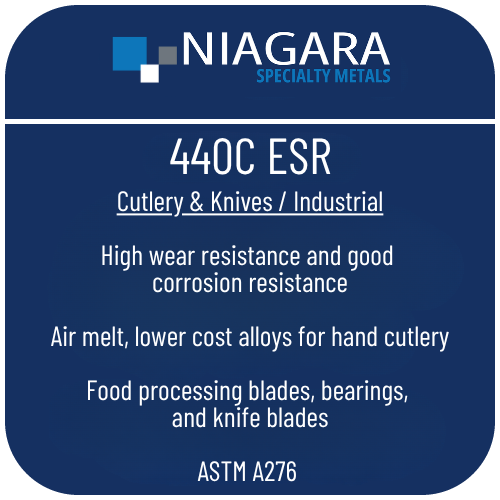
Industries: Cutlery & Knives / Industrial
- High wear resistance and good corrosion resistance
- Air melt, lower cost alloys for hand cutlery
- Food processing blades, bearings, and knife blades
- ASTM A276
- Manufactured in the USA
For a data sheet on 440C ESR Stainless Knife Steel, please click here
Tolerance and Finish
Material is sandblasted to a gray matte finish.
The thickness and width are supplied oversize to finish at the requested dimension.
Cutting Methods
All orders will be sheared to size unless the width is too narrow.
$100 minimum per order please.
All dimensions are in inches.
The length can range from 35-1/2 to 38 inches.
The width for 24" sheets can range from 23 to 25 inches.
440C ESR stainless knife steel delivers high wear resistance and corrosion protection for premium blades and precision components.
Hot rolled & processed by the employee owners of Niagara Specialty Metals in Akron NY
- Take a virtual tour of Niagara Specialty Metals. Click here to watch the full plant tour on YouTube.
- Learn more about our Specialty Metals for Cutlery and Knives. Click here to explore the full range of knife steels we supply.
- Learn more about our Specialty Metals for Industrial Applications. Click here to explore the full range of industrial metal grades we supply.
Cut Method by Thickness / Width
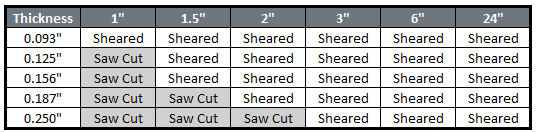
| Surface Finish | Descaled |
|---|---|
| Width | 1", 1.5", 2", 3", 6", 24" |
| Thickness: .103/.113 thick will finish at | .093" thick |
| Thickness: .140/.156 thick will finish at | .125” thick |
| Thickness: .172/.188 thick will finish at | .156” thick |
| Thickness: .207/.227 thick will finish at | .187” thick |
| Thickness: .275/.300 thick will finish at | .250” thick |
| Length can range from | 35 1/2" to 38" |
440C ESR Stainless Knife Steel Data Sheet
Typical Composition
| C | Mn | Si | Cr | P | Mo | S |
|---|---|---|---|---|---|---|
| 0.95/1.20 | 1.00 | 1.00 | 16.00/18.00 | 0.40 | 0.75 | 0.03 |
440C ESR is a hardenable chromium steel. It has one of the highest attainable hardnesses of the corrosion and heat resisting grades. This grade is magnetic at all times. For those applications where superior machinability is desired and where slightly lower corrosion resistance is satisfactory 440C ESR can be supplied.
Typical Applications: Ball bearings, bushings, valve parts and cutlery.
Cutlery Applications
440C ESR is particularly designed for cutlery applications requiring a high hardness and an excellent retention of the cutting edge. When this grade is ordered specifically for mirror–finish cutlery applications, material will be supplied which has been processed in such a manner as to insure the obtaining of a polished surface of “mirror finish” quality. Care should be taken in grinding and polishing this grade so that excessive heat is not produced by this operation as the resistance to staining will be lowered. In general, 440C ESR resembles tool steels in that it requires great care in fabrication and hardening.
Forging
440C ESR should be forged at 1950 to 2050°F and finished not lower than 1750°F. Reheating should be used if necessary. This grade should be allowed to cool slowly after forging.
Annealing
440C ESR should be annealed for maximum softness by thorough soaking at 1650°F for six hours followed by a furnace cool. This grade can be *cycle annealed by heating to 1600°F, holding two hours, cooling to 1300°F, and holding four hours. The steel may be cooled in air if desired.
*Cycle (isothermal) annealing is most practical for applications in which full advantage may be taken of the rapid cooling to the transformation temperature and from this temperature down to room temperature. Thus, for small parts which can be conveniently handled in salt or lead baths, this isothermal annealing makes possible large time savings as compared with the conventional slow furnace cooling. The method offers no particular advantage for applications such as batch annealing of large furnace loads in which the rate of cooling to the center of load may be so slow as to preclude any rapid cooling to the transformation temperatures. For such applications, the conventional full annealing method usually offers better assurance of obtaining the desired microstructure and properties.
Hardening and Tempering
440C ESR can be hardened for maximum hardness by oil quenching or air cooling from 1850 to 1900°F. Large sections or complex parts should be preheated to 1425°F, equalize, and then raised to the austenitizing temperature. If the finished part is not to be ground and polished, the surface may be improved by packing in a neutral material during heating. Tempering should be at the proper temperature to give the desired approximate hardness as indicated below.
| Tempering Temperature (°F) | HRC |
|---|---|
| As quenched | 59 |
| 212° | 59 |
| 400° | 56 |
| 600° | 54 |
| 800° | 55 |
| 1000° | 51 |
It is desirable to avoid tempering between 800 and 1100°F, as there is a drop in impact strength within this range, coincidental with which there is also a reduction in resistance to corrosion.
Welding
440C ESR should be welded with Type 440C ESR filler weld metal if the mechanical properties of the weld metal must be similar to those of the parent metal. In welding annealed material, the steel should be preheated to 600°F and annealed following welding by heating uniformly and thoroughly at 1300°F followed by the air cooling. When welding hardened and tempered material, preheat to the tempering temperature, weld and post–heat at the appropriate tempering temperature for 2 hours.
Resistance to Scaling
440C ESR scales at approximately 1400°F. This temperature will vary with the type of atmosphere, type of construction, and cycle of operation.
General Corrosion Resistance
440C ESR is resistant to corrosion in atmosphere environments, fresh water, mild acids, alkalies, and fruit and vegetable juices. The better the finish of the hardened and tempered part, the better will be its corrosion resistance.
Machining Data
440C ESR Stainless Steel
| Operation | Tooling Width or Depth of Cut (in) | High Speed Tooling* | Carbide Tooling | ||
|---|---|---|---|---|---|
| Speed (fpm) | Feed (in/rev) | Speed (fpm) | Feed (in/rev) | ||
| Turning Single Point | 0.050 | 65 | 0.0045 | 200 | 0.010 |
| 0.250 | 65 | 0.0040 | 200 | 0.020 | |
| 0.500 | 60 | 0.0035 | 175 | 0.025 | |
| Forming | 1/2 wide | 65 | 0.0012 | 120 | 0.002 |
| 1 wide | 65 | 0.0010 | 120 | 0.002 | |
| 1.5 wide | 60 | 0.0008 | 120 | 0.002 | |
| 2 wide | 60 | 0.0008 | 120 | 0.001 | |
| Cutoff | 1/16 wide | 60 | 0.0010 | 120 | 0.002 |
| 1/8 wide | 60 | 0.0010 | 120 | 0.002 | |
| 3/16 wide | 65 | 0.0012 | 120 | 0.002 | |
| 1/4 wide | 65 | 0.0015 | 120 | 0.003 | |
| Drilling | 1/16 dia. | 40 | 0.0010 | ||
| 1/8 dia. | 40 | 0.0020 | |||
| 1/4 dia. | 45 | 0.0025 | |||
| 1/2 dia. | 45 | 0.0030 | |||
| 3/4 dia. | 45 | 0.0035 | |||
| 1 dia. | 45 | 0.0040 | |||
*Use the higher speeds for the finer threads.
Specifications
440C ESR has found wide industry acceptance and meets the following specifications:
| QQ-S-763d | AMS 5630C | ASTM A-276-67 | ASTM A-580-67 |
|---|
This data sheet is for informational purposes only. Alloy characteristics are subject to change due to chemical composition and/or processing. We do not certify the material’s suitability for specific applications.