Maraging Steel C250 and C300: How to Choose the Right Grade for Your Application
May 18th 2026
When it comes to maraging steel C250 and C300, every smart order starts with one question: What’s the application?
According to Carl Stroud, Sales Manager at Niagara Specialty Metals (NSM), the conversation always begins there. Before you talk about price, finish, or delivery, you need to understand how the steel will be used. That single question can prevent costly rework, delays, and mismatched material later.
In this post, Carl walks through how NSM approaches maraging steel, from choosing the right grade (C250 vs. C300) to understanding solution treatment, aging, and surface condition. You’ll learn what questions to ask your supplier and how to place a clean, compliant order that makes your fabrication smoother.
Start With the Application
Carl starts every conversation the same way:
“What’s the application? … What are you doing with it?”
Once he knows that, he looks at who specified the grade. Many maraging steel requests come directly from defense programs. “Some engineer in the military said, this is what we’re making,” Carl explains. That means the goal is precision and compliance, not substitution.
Then come the practical details:
- Will you form and then age the parts?
- Or will you cut parts from the plate and age them later?
- What surface condition do you need?
Those details determine how the steel should be supplied and processed.
What “Maraging” Really Means
Carl breaks it down simply: the word maraging comes from martensite and aging. It’s a combination of two key steps, creating a martensitic structure and then strengthening it through a controlled aging process.
Unlike PH stainless steels like 15-5PH, which harden through precipitation alone, maraging steels depend on martensitic transformation followed by age hardening. They also differ from quench-and-temper steels used in knives and tools, which use tempering instead of aging.
So, in simple terms:
- Maraging steel: martensitic structure + aging = strength
- PH stainless: precipitation hardening = strength
- Tool steel: martensitic structure + tempering = strength
Understanding the Family of Grades
Carl describes maraging steel as “a family of grades.” The most common are C200, C250, C300, and C350, but for Niagara Specialty Metals, C250 and C300 are the main workhorses.
“You have at least three of them that I know of 200, 250, and 300,” Carl notes. “But 250 and 300 are your two primary grades.”
These two cover most aerospace, defense, and high-performance industrial needs. Their combination of high strength, toughness, and stability during heat treatment makes them ideal for structural parts, tooling, and components that can’t afford distortion.
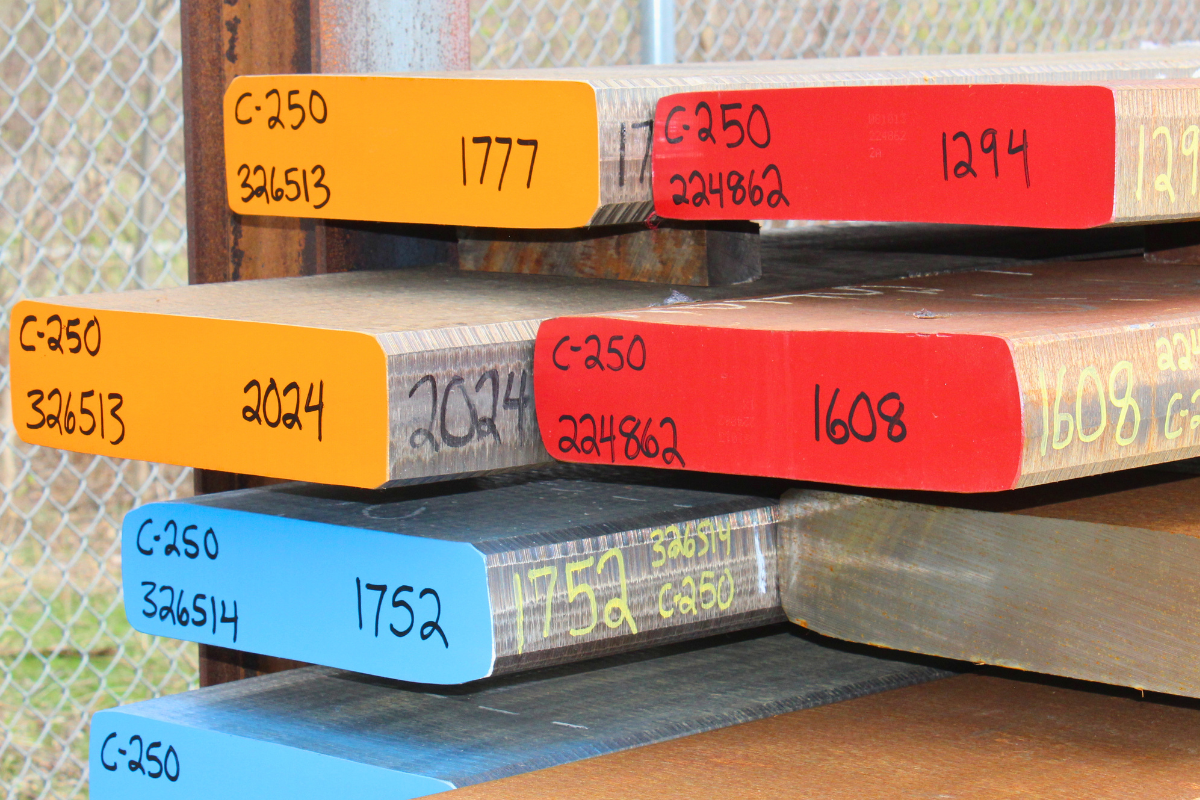
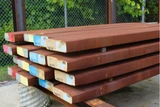
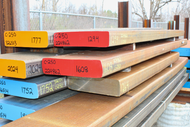
Maraging steel C250 billet in the Niagara Specialty Metals billet yard, staged for precision processing and ready to be supplied in solution-treated condition.
The Supply State: Solution Treated and Ready to Age
NSM supplies maraging steel C250 and C300 in the solution-treated condition. This state is soft enough for forming, machining, or cutting before the customer performs the age-hardening step.
“We supply it in the solution treated condition … and then the customer would typically do the age hardening,” says Carl.
This process ensures dimensional stability and minimal distortion when parts reach final strength.
Key Properties of Maraging Steel C250 and C300
Carl’s review of the alloy guide confirms what makes maraging steel stand out:
- Ultra-high strength after aging
- Excellent toughness
- Minimal distortion through heat treatment
- Good weldability
- Magnetic properties
- Limited corrosion resistance (plan coatings if needed)
These traits make C250 and C300 ideal for aerospace structures, missile components, and high-temperature tooling where stability and repeatability matter most.
What to Ask Before Ordering
Carl emphasizes that ordering maraging steel is about asking the right questions:
- What application are you serving?
- What specification or program requirement applies (AMS 6520, AMS 6521, or MIL-S-46850)?
- Will you form, then age, or cut, then age?
- What surface finish as rolled, ground, or precision-flattened best fits your process?
- Do you need DFARS compliance or a domestic melt?
Answering these questions upfront ensures that the plate or sheet you receive performs exactly as intended.
C250 vs. C300: How to Decide
Both grades deliver exceptional strength, but they serve slightly different needs:
- Maraging Steel C250 – balances high strength with superior toughness and is easier to form before aging.
- Maraging Steel C300 – offers even higher strength for critical load-bearing parts.
If your print specifies one, follow it. If you have a choice, decide based on your required mechanical properties, forming sequence, and thickness. When in doubt, confirm the aging cycle that achieves your target strength.
Forms, Finishes, and Processing
At Niagara Specialty Metals, maraging steel C250 and C300 are available as plate and flat-rolled sheet. The company provides:
- Precision flattening
- Grinding and cutting (laser, waterjet, or saw)
- Conversion processing on customer-supplied alloys
These steps help ensure your maraging plate arrives within tolerance and ready for downstream fabrication.
Carl recommends matching your surface and flatness specs to your manufacturing steps. For example:
- Blasted surfaces are clean and ready for inspection.
- Ground finishes are ideal when tight thickness is critical.
- Precision-flattened sheets simplify laser or waterjet cutting.
Why Solution Treatment Matters
Because maraging steels are supplied in the solution-treated state, they are easier to form or machine before aging. Once aging is done, strength increases dramatically—often beyond 250 ksi. Performing fabrication before aging reduces distortion and saves rework time later.
This sequence solution treat → form → age is central to NSM’s maraging workflow. It helps maintain tight tolerances and consistent quality across every batch.
Compliance and Specification Integrity
Aerospace and defense customers often require traceability. Niagara Specialty Metals provides DFARS-compliant, domestically melted maraging steel C250 and C300 that meet:
- AMS 6520 / AMS 6521
- MIL-S-46850
Locking in the correct specification early ensures certification, test data, and heat lot traceability align from the start.
The Niagara Specialty Metals Approach
Niagara Specialty Metals focuses on small to mid-sized lots, short lead times, and precision flat-rolled product. Every maraging plate passes through a combination of rolling, flattening, and inspection steps designed to meet the high standards of aerospace and defense customers.
The company’s employee-ownership culture reinforces accountability from production to delivery. As Carl notes, guides like this one aren’t just marketing—they’re tools for better conversations with engineers and buyers.
Buyer’s Quick Checklist for Maraging Steel C250 and C300
- Define your application – What’s the part? What does it do?
- Confirm grade and spec – AMS 6520, AMS 6521, or MIL-S-46850.
- Plan your process – Will you form or cut before aging?
- Select surface condition – As rolled, blasted, ground, or precision-flattened.
- Confirm compliance – DFARS and domestic melt if required.
- Verify finish and flatness – Match your forming and cutting steps.
- Align aging cycle – Ensure your heat treatment plan hits the target properties.
Follow these steps, and your order will be clear, compliant, and ready for production.
Conclusion: Clear Questions Create Stronger Results
For Carl Stroud, success with maraging steel C250 and C300 starts with clarity. Ask about the job. Know the grade. Plan the path from forming to aging.
“What’s the application?” he says. “That’s always the first question.”
When you understand the process, from solution-treated supply to final aged properties, you avoid delays and build stronger, more consistent parts. That mindset defines Niagara Specialty Metals’ approach to every maraging steel order precision, reliability, and partnership that lasts beyond the purchase order.
Looking to learn more about Niagara Specialty Metal's maraging steel? Check out some of our related blogs here:
Inside the Maraging Steel Supply Chain Process: How Smart Planning Cuts Lead Time from 10 Weeks to 1
For more information, check out our other blogs.
Click here to view our product catalog at our updated e-commerce store!
Interested in additional information on knife steel or CPM® MagnaCut stainless steels? Click here!