
CTS XHP Data Sheet
Identification
U.S Patent Number: 5,370,750
Type Analysis
Some figures are nominal except where noted.
| Carbon | 1.60 % | Manganese | 0.50 % |
| Silicon | 0.40 % | Chromium | 16.00 % |
| Nickel | 0.35 % | Molybdenum | 0.80 % |
| Vanadium | 0.45 % | Iron | Balance |
CTS XHP is a powder metallurgy, air-hardening, high carbon, high chromium, corrosion-resistant alloy. It can be considered either a high hardness 440C stainless steel or a corrosion-resistant D-2 tool steel. CTS XHP posesses corrosion resistance equivalent to 440C stainless steel and can attain a maximum hardness of 64 HRC. In addition, the composition of CTS XHP has been balanced so that it can attain a minimum hardness of 60 HRC when air cooled from hardening temperatures of 1850-2000°F (1010-1093°C). CTS XHP is thus more forgiving during heat treatment than similar alloys.
Typical Applications: CTS XHP can be used for specialty knives where the alloy's fine carbide distribution can be used to produce a keenly sharp cutting edge. The material can be easily ground to the thin profiles required for cutting tools. CTS XHP knife blades can be finely polished to high luster or produced with uniform matte finish.
Corrosion Resistance
CTS XHP posesses corrosion resistance equivalent to Type 440C stainless. CTS XHP resists corrosion in normal domestic environments and very mild industrial environments, including many petroleum products and organic materials.
For optimium corrosion reisstance, surfaces must be free of scale and foreign particles and finished parts should be passivated.
Detailed test data can be furnished upon request.
IMPORTANT NOTE: The following 4-level rating scale is intended for comparative purposed only. Corrosion testing is recommended; factors which effect corrosion resistance include temperature, concentration, pH, impurities, aeration, velocity, crevices, deposits, metallurgical condition, stress, surface finish, and dissimilar contact.
| Nitric Acid | Moderate | Sulfuric Acid | Restricted |
| Phosphoric Acid | Restricted | Acetic Acid | Restricted |
| Sodium Hydroxide | Moderate | Salt Spray (NaCl) | Restricted |
| Humidity | Good |
Physical Properties
Specific Gravity: 7.62
Density: 0.2750 lb/in^3
Effect of Refrigeration on As-Hardened Condition
Hardness measurements are averages rounded to the nearest 0.5 HRC.
Sample Size: 1 inch diameter x 0.5-inch thickness
Heat Treatment: 25 minutes at hardening temperature, then air cool or oil quench to room temperature. Leave as-hardened, or refrigerate at -100°F (-73°C) for 1 hour.
Air warm to room temperature.
| Hardening Temperature | Air Cool Only | Air Cool + Refrigeration |
Oil Quench Only | Oil Quench + Refrigeration |
|
|---|---|---|---|---|---|
| °F | °C | ||||
| 1850 | 1010 | 62.0 | 62.5 | 62.5 | 63.5 |
| 1900 | 1038 | 62.5 | 63.5 | 63.0 | 64.0 |
| 1950 | 1066 | 62.5 | 64.0 | 62.5 | 64.5 |
| 2000 | 1093 | 58.5 | 64.0 | 57.0 | 64.0 |
Heat Treatment
Decarburization
CTS XHP, like all high carbon tool steels, is subject to decarburization during thermal processing and precautions must be taken to control this condition.
Annealing
CTS XHP should be annealed ina neutral atmosphere. Heat iniformly to 1550-1600°F (848-871°C), then cool very slowly in the furnace at a rate of not more than 20°F (11°C) per hour until the furnace is black. The furnace may be turned off and allowed to cool naturally.
Annealed Hardness: about 230/255 HBN
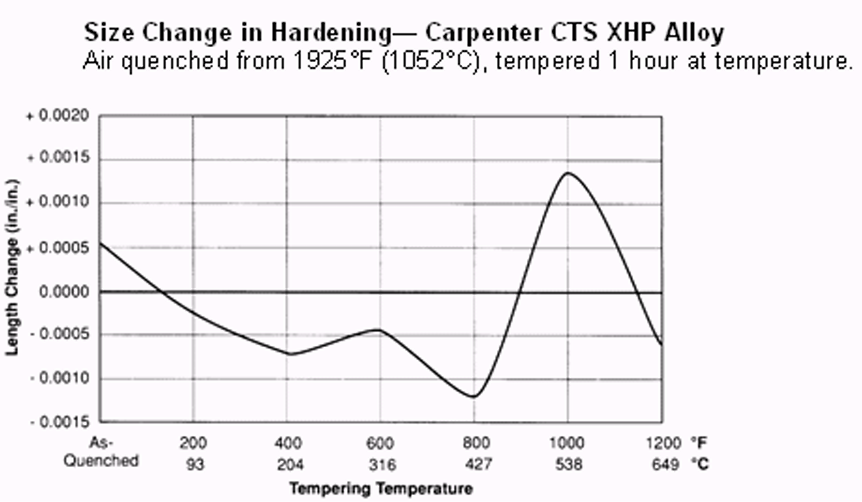
Effect of Refrigeration on Tempered Hardness
Hardness measurements are averages rounded to the nearest 0.5 HRC.
Sample Size: 1 inch diameter x 0.5 inch thickness
Heat Treatment: 25 minutes at hardening temperature. Air cool or oil quench. Leave as-hardened, or refrigerate at -100°F (-73°C) for 1 hour. Air warm. Temper 1 hour at temperature. Air cool.
| Tempering Temperature |
Air Cool Only |
Air Cool + Refrigeration |
Oil Quench Only |
Oil Quench + Refrigeration |
|
|---|---|---|---|---|---|
| °F | °C | ||||
| 1900°F (1038°C) Hardening Temperature | |||||
| As-Hardened | 62.5 | 63.5 | 63.0 | 64.0 | |
| 200 | 93 | 63.0 | 64.0 | 63.0 | 64.0 |
| 250 | 121 | 63.0 | 64.0 | 63.0 | 64.0 |
| 300 | 149 | 62.0 | 63.0 | 62.0 | 63.0 |
| 350 | 177 | 61.0 | 62.0 | 61.0 | 62.0 |
| 400 | 204 | 60.5 | 62.0 | 60.5 | 61.0 |
| 450 | 232 | 60.0 | 61.0 | 59.5 | 60.5 |
| 500 | 260 | 59.0 | 60.5 | 59.0 | 60.0 |
| 600 | 316 | 58.0 | -- | -- | - |
| 800 | 427 | 58.0 | |||
| 1950°F (1066°C) Hardening Temperature | |||||
| As-Hardened | 62.5 | 64.0 | 62.5 | 64.5 | |
| 200 | 93 | 62.5 | 65.0 | 62.5 | 65.0 |
| 250 | 121 | 62.5 | 65.0 | 62.0 | 65.0 |
| 300 | 149 | 62.0 | 64.0 | 61.5 | 64.0 |
| 350 | 177 | 61.0 | 63.0 | 60.5 | 63.0 |
| 400 | 204 | 60.5 | 62.5 | 60.0 | 62.5 |
| 450 | 232 | 59.5 | 61.5 | 59.0 | 61.5 |
| 500 | 260 | 59.0 | 61.0 | 57.5 | 60.5 |
| 600 | 316 | 57.5 | -- | -- | -- |
| 800 | 427 | 57.5 | -- | -- | -- |
For maximum corrosion resistance, do not temper above 800°F (427°C)
Workability
Forging
CTS XHP forges very much like high-speed steels. Preheat to 1400-1500°F (760-816°C), then slowly heat slowly and uniformly to 1900-2100°F (1038-1149°C). Do not forge below 1700°F (927°C), and reheat as often as necessary. Cool in a furance heated to about 1550°F (843°C), soak uniformly at this temperature, then shut off the heat and cool slowly in the furnace. Anneal after forging. Cool to room temperature before annealing.
Machinability
The following chart contains suggested speeds and feeds for machining CTS XHP.
Turning- Single-Point and Box Tools
| Depth of Cut (inches) |
High Speed Tools | Carbide Tools (Inserts) | |||||
|---|---|---|---|---|---|---|---|
| Tool Material | Speed (fpm) | Feed (ipr) | Tool Material | Speed (fpm) | Feed (ipr) | ||
| Uncoated | Coated | ||||||
| .150 | T15 | 65 | .015 | C6 | 300 | 350 | .015 |
| .025 | M42 | 75 | .007 | C7 | 350 | 450 | .007 |
Turning - Cut-Off and Form Tools
| Tool Material | Speed (fpm) |
Feed (ipr) | |||||||
|---|---|---|---|---|---|---|---|---|---|
| High Speed Tools |
Carbide Tools |
Cut-Off Tool Width (inches) | Form Tool Width (inches) | ||||||
| 1/16 | 1/8 | 1/4 | 1/2 | 1 | 1 ½ | 2 | |||
| T15 | C6 | 50 | .001 | .001 | .0015 | .001 | .001 | .001 | .0015 |
| 175 | .003 | .003 | .0045 | .003 | .002 | .002 | .002 | ||
Rough Reaming
| High Speed | Carbide Tools | Feed (ipr) Reamer Diameter (inches) | |||||||
|---|---|---|---|---|---|---|---|---|---|
| Tool Material | Speed (fpm) | Tool Material | Speed (fpm) | 1/8 | 1/4 | 1/2 | 1 | 1 ½ | 2 |
| T15 | 57 | C2 | 75 | .003 | .006 | .010 | .015 | .018 | .021 |
Drilling
| High Speed Tools | |||||||||
|---|---|---|---|---|---|---|---|---|---|
| Tool Material | Speed (fpm) | Feed (inches per revolution) Nominal Hole Diameter (inches) | |||||||
| 1/16 | 1/8 | 1/4 | 1/2 | 3/4 | 1 | 1 ½ | 2 | ||
| T15, M42 | 40-50 | .001 | .003 | .005 | .007 | .009 | .011 | .014 | .018 |
Die Threading
| FPM for High Speed Tools | ||||
|---|---|---|---|---|
| Tool Material | 7 or less, tpi | 8 to 15, tpi | 16 to 24, tpi | 25 and up, tpi |
| T15, M42 | 5-12 | 8-15 | 10-20 | 15-25 |
Milling - End-Peripheral
| Depth of Cut (inches) |
High Speed Tools | Carbide Tools | ||||||||||
|---|---|---|---|---|---|---|---|---|---|---|---|---|
| Tool Material | Speed (fpm) | Feed (ipt) Cutter Diameter (in) | Tool Material | Speed (fpm) | Feed (ipt) Cutter Diameter (in) | |||||||
| 1/4 | 1/2 | 3/4 | 1-2 | 1/4 | 1/2 | 3/4 | 1-2 | |||||
| .050 | M2, M7 | 70 | .001 | .002 | .003 | .004 | C6 | 235 | .001 | .002 | .004 | .006 |
Tapping
| High Speed Tools | |
|---|---|
| Tool Material | Speed (fpm) |
| M1, M7, M10 Nitrided | 8-18 |
Broaching
| High Speed Tools | ||
|---|---|---|
| Tool Material | Speed (fpm) | Chip Load (cpt) |
| T15, M42 | 10 | .002 |
Additional Machinability Notes
When using carbide tools, surface speed feet/minute (SFPM) can be increased between 2 and 3 times over the high-speed suggestions. Feeds can be increased between 50% and 100%.
Figures used for all metal removal operations covered are average. On certain work, the nature of the part may require adjustment of speeds and feeds. Each job has to be developed for best production results with optimum tool life. Speeds or feeds should require increased or decreased in small steps.
Wear Resistance
The wear characteristics in the table below were generated using ASTM G65 Procedure "A", the Standard Practice for conducting Dry Sand/ Rubber Wheel Abrasion Tests. The data presented as volume loss as required by the ASTM Standard. It should be notes therefore that a lower number means better wear resistance.
Heat Treatments:
CTS XHP
1925°F (1052°C) (25 minutes). Air Cool/-100°F (-73°C)
(1 hour) Air Warm/350°F (177°C) (1 hour) Air Cool
440C
1900°F (1038°C) (25 minutes). Oil Quench/-100°F (-73°C)
(1 hour) Air Warm/350°F (177°C) (1 hour) Air Cool
D-2
1850°F (1010°C) (25 minutes). Air Cool-As Hardened
| Material | Hardness, HRC | Average ASTM Volume Loss (mm³) |
|---|---|---|
| CTS XHP Alloy | 62.5 | 35.1 |
| 440C | 58.5 | 66.9 |
| D2 | 63.5 | 37.6 |
This data sheet is for informational purposes only. Alloy characteristics are subject to change due to chemical composition and/or processing. We do not certify the material’s suitability for specific applications.
Niagara Specialty Metals | 12600 Clarence Center Road, Akron, NY 14001