

CPM® 20CV PM Knife Steel
Industries: Cutlery & Knives
- CPM® alloy for hand cutlery
- Premium powder metallurgy stainless steel with outstanding edge retention, high corrosion resistance, and excellent overall wear performance
- High chromium and vanadium content give it a fine, stable carbide structure that holds an edge exceptionally well while still resisting rust
- Top choice for high-end EDC knives and demanding cutting tools where long-lasting sharpness and durability are essential
- Manufactured in the USA
For a data sheet on CPM® 20CV PM Knife Steel, please click here
Tolerance and Finish
Material is sandblasted to a gray matte finish.
The thickness and width are supplied oversize to finish at the requested dimension.
Cutting Methods
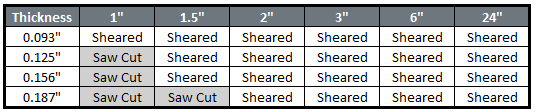
All orders will be sheared to size unless the width is too narrow.
$100 minimum per order please.
All dimensions are in inches.
The length can range from 35-1/2 to 38 inches.
The width for 24" sheets can range from 23 to 25 inches.
CPM® 20CV PM knife steel offers exceptional edge retention, corrosion resistance, and superior wear performance for high-end blades.
Hot rolled & processed by the employee owners of Niagara Specialty Metals in Akron NY
- Take a virtual tour of Niagara Specialty Metals. Click here to watch the full plant tour on YouTube.
- Learn more about our Specialty Metals for Cutlery and Knives. Click here to explore the full range of knife steels we supply.
Cut Method by Thickness / Width
| Surface Finish | Ground |
|---|---|
| Width | 1", 1.5", 2", 3", 6", 24" |
| Thickness: .103/.113 thick will finish at | .093" thick |
| Thickness: .140/.156 thick will finish at | .125” thick |
| Thickness: .172/.188 thick will finish at | .156” thick |
| Thickness: .207/.227 thick will finish at | .187” thick |
| Thickness: .275/.300 thick will finish at | .250” thick |
| Length can range from | 35 1/2" to 38" |
CPM® 20CV PM Knife Steel Data Sheet
Typical Composition
| C | Cr | Mo | V | W |
|---|---|---|---|---|
| 1.90 | 20.00 | 1.00 | 4.00 | 0.60 |
CPM® 20CV is a unique tool steel. It is a martensitic stainless steel with a high volume of vanadium carbides for exceptionally good wear resistance. CPM® 20CV contains the highest amount of chromium of any high–vanadium stainless steel currently available. The chromium–rich matrix provides outstanding corrosion resistance. CPM® 20CV is an excellent steel for plastic injection feed screws, barrel liners, screw tips and mold cavities, especially for plastic resins which contain abrasive fillers.
The CPM® process results in a finer, more uniform carbide distribution imparting improved toughness and grindability to highly alloyed steels. The CPM® process also allows for the design of more highly alloyed grades which cannot be produced by conventional steelmaking.
Typical Applications: High performance, long–wearing specialty cutlery, plastic injection and extrusion feed screws and dies, granulator knives, pelletizing equipment, wear components for food and chemical processing.
Edge Retention
(CATRA Test Relative to 440C ESR)
| Grade | % |
|---|---|
| CPM® 20CV | 180 |
| 14-2-4 CrMoV | 145 |
| 14-4 CrMo | 120 |
| 440C ESR | 100 |
The CATRA (Cutlery & Allied Research Association) test machine measures the total number of silica–impregnated cards cut in a sequence of passes along the blade. It is considered a relative measure of edge retention and wear resistance.
Physical Properties
Density: 0.275 lb/in^3 (7616 kg/m^3)
Modulus of Elasticity: 31x10^6 psi (214 GPa)
Machinability: 35–40% of a 1% carbon steel
Coefficient of Thermal Expansion
| Temperature °F | in/in/°F x 10^-6 | Temperature °C | mm/mm/°C x 10^-6 |
|---|---|---|---|
| 68-212 | 6.06 | 20-100 | 10.9 |
| 68-392 | 6.23 | 20-200 | 11.2 |
| 68-572 | 6.56 | 20-300 | 11.8 |
| 68-752 | 6.73 | 20-400 | 12.1 |
| 68-932 | 6.84 | 20-500 | 12.3 |
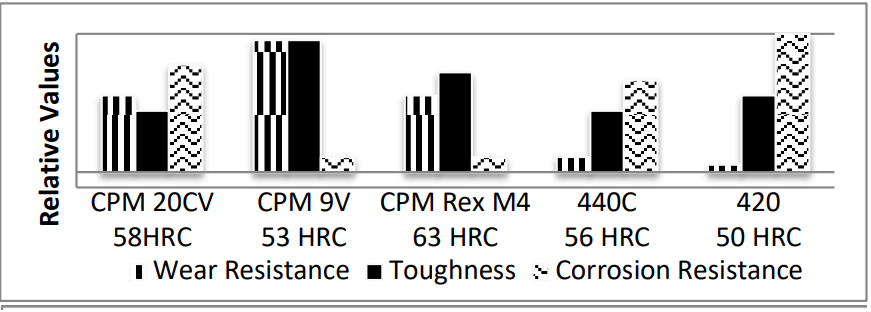
Steel Comparagraph
Thermal Treatments
Annealing
Annealing must be performed after hot working and before rehardening. Heat at a rate not exceeding 400°F per hour (222°C per hour) to 1860–1900°F (1016–1038°C) and hold at temperature for 1 hour per inch (25.4 mm) of maximum thickness; 2 hours minimum. Then cool slowly with the furnace at a rate not exceeding 30°F per hour (15°C per hour) to 1000°F (538°C). Continue cooling to ambient temperature in the furnace or in air. The resultant hardness should be approximately 30 HRC or lower. Another option is subcritical anneal. Heat to 1450°F (788°C) and hold for 4 to 6 hours. Furnace cool 15°/hr to 1250°F, hold for 4 hours, then furnace cool until black (about 900°F) before pulling the hood.
Hardening
Preheat: Heat to 1400–1450°F (760–788°C) and equalize.
Austenitize: Heat rapidly from the preheat to a temperature to within 1960–2150°F (1071–1177°C). A lower austenitizing temperature will maximize impact toughness. A higher austenitizing temperature will maximize wear resistance and corrosion resistance. Soak at the austenitizing temperature for 30 minutes. Austenitizing between 2050°F and 2150°F should be done in a vacuum furnace.
Quench: Pressurized gas or warm oil. For pressurized gas, the furnace should have a minimum quench pressure of 4 bars. A quench rate of approximately 400°F (222°C) per minute to below 1000°F (538°C) is critical to obtain the desired properties. For oil, quench until black, about 900°F (482°C), then cool in still air to 150–125°F (66–51°C).
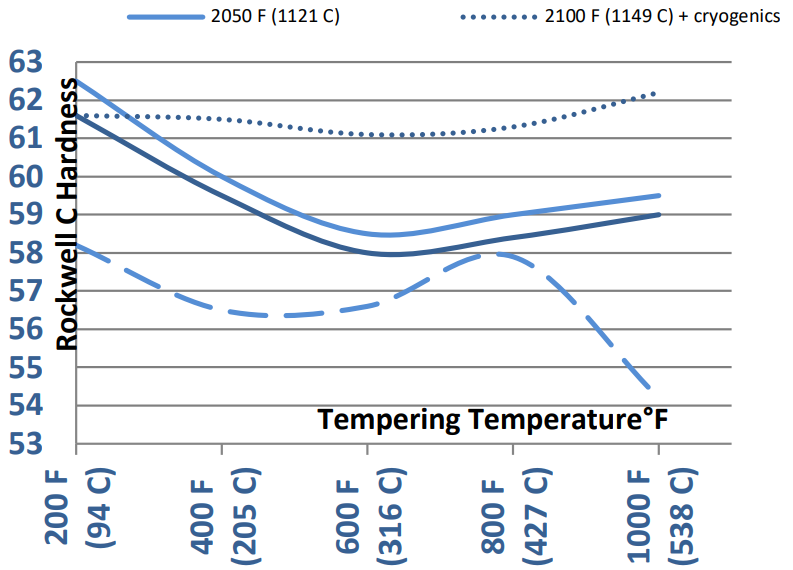
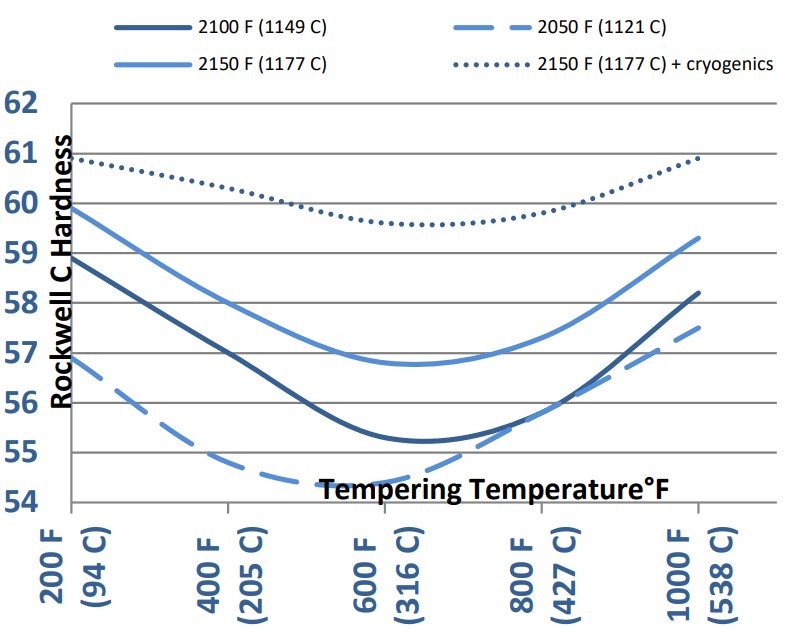
Temper: Temper immediately after quenching, or after quenching and cryogenic treatment. Typical temperature range is 400–800°F (204–427°C). Hold at temperature for 1 hour per inch (25.4 mm) of thickness, 2 hours minimum, then air cool to ambient temperature. The typical service hardness is 56–59 HRC, although higher hardness may be used for increased wear resistance.
Tempering between 800 and 1100°F (427–583°C) will decrease corrosion resistance and toughness.
Cryogenic Treating: For austenitizing at 2100°F (1149°C) or higher, a cryogenic treatment is recommended after quenching to 150 to 125°F (66–51°C) to reduce retained austenite. Cool to –100°F (–73°C), remove from the cooling medium, and allow part to warm to ambient temperature in still air.
Heat Treatment Response
For Furnace or Salt Bath Hardening:
Oil Quenched from
This data sheet is for informational purposes only. Alloy characteristics are subject to change due to chemical composition and/or processing. We do not certify the material’s suitability for specific applications.