MagnaMax Steel Performance Explained
May 11th 2026
The Science Behind MagnaMax® Knife Steel Performance
MagnaMax® knife steel performance comes from a refined microstructure that improves edge retention, corrosion resistance, and toughness compared to older high wear resistance stainless steels. The steel achieves that balance by eliminating large chromium carbides and using fine vanadium and niobium carbides instead.
Knife users often focus on steel names or hardness numbers. However, the real performance of a knife steel starts at the microscopic level. Dr. Larrin Thomas explained how MagnaMax® builds on the MagnaCut® design philosophy to create a stainless steel with significantly higher edge retention while maintaining excellent corrosion resistance and strong toughness. In this interview with Niagara Specialty Metals, Larrin broke down the science behind MagnaMax® and why its carbide structure changes knife performance.
The Tradeoff Between Toughness and Edge Retention
Every knife steel involves a tradeoff between toughness and edge retention. As wear resistance increases, toughness naturally decreases.
Larrin explained that wear resistance helps a knife maintain its cutting edge longer when cutting abrasive materials like cardboard or rope. However, increasing wear resistance usually requires adding more hard carbides to the steel. Those carbides improve cutting performance but reduce toughness.
He compared this concept to older non-stainless steels that used different vanadium levels such as 1V, 3V, 4V, 10V, and 15V. As vanadium increases, the steel gains more hard vanadium carbides and stronger wear resistance. At the same time, toughness drops.
Different knives require different balances. Axes and chopping knives need high toughness because they experience heavy impacts. Folding knives and EDC blades often prioritize edge retention because users want longer cutting performance between sharpening sessions.
MagnaMax® pushes further toward edge retention while still maintaining much better toughness than many older high wear resistance stainless steels.
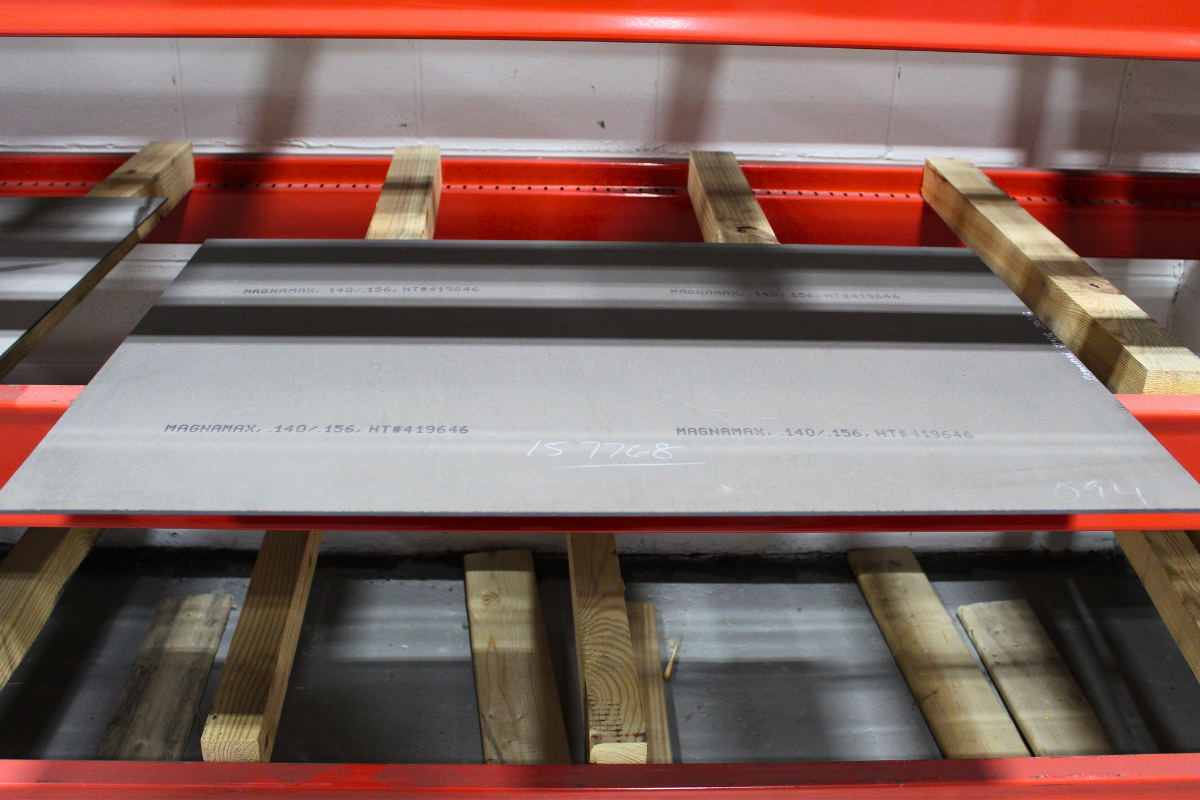
Finished MagnaMax® sheet ready for processing and delivery from the Niagara Specialty Metals warehouse.
Why Edge Geometry Matters More Than Most Buyers Realize
Edge geometry affects knife performance even more than steel choice. A thinner, more acute edge cuts better and lasts longer during slicing tasks.
Larrin explained that many knife buyers focus heavily on steel specifications while overlooking geometry. However, the shape of the edge strongly influences cutting efficiency and durability.
An acute edge slices more aggressively and continues cutting efficiently as the edge slowly wears. In contrast, a thicker, more obtuse edge sacrifices cutting ability for strength.
The challenge is that higher wear resistance steels often require thicker edges because reduced toughness increases the risk of chipping. MagnaMax® changes that balance.
According to Larrin, MagnaMax® has roughly double the toughness of older high wear resistance stainless steels like S90V, 20CV, or M390. As a result, knife makers can use thinner edge geometry while still benefiting from dramatically improved edge retention.
That balance gives MagnaMax® a major advantage for folding knives and high-performance EDC blades.
What Makes MagnaMax® Different at the Microstructure Level
MagnaMax® performs differently because it eliminates large chromium carbides and replaces them with finer vanadium and niobium carbides.
Larrin explained that large chromium carbides create several problems in knife steels. When sharpening a blade to a very fine edge, oversized carbides can pull out of the edge and leave tiny divots behind. Those divots reduce edge stability and toughness.
Large carbides also hurt grinding performance. Abrasives struggle to cut through oversized carbides efficiently, which increases wear on grinding equipment and sharpening tools.
MagnaMax® avoids those issues by creating a much finer carbide structure. Instead of relying on large chromium carbides, the alloy uses small vanadium and niobium carbides distributed more evenly throughout the steel.
That finer microstructure improves sharpening behavior, grinding efficiency, edge stability, and overall toughness.
Larrin noted that MagnaMax® has a significantly finer carbide structure than older stainless steels like M390 or 20CV.
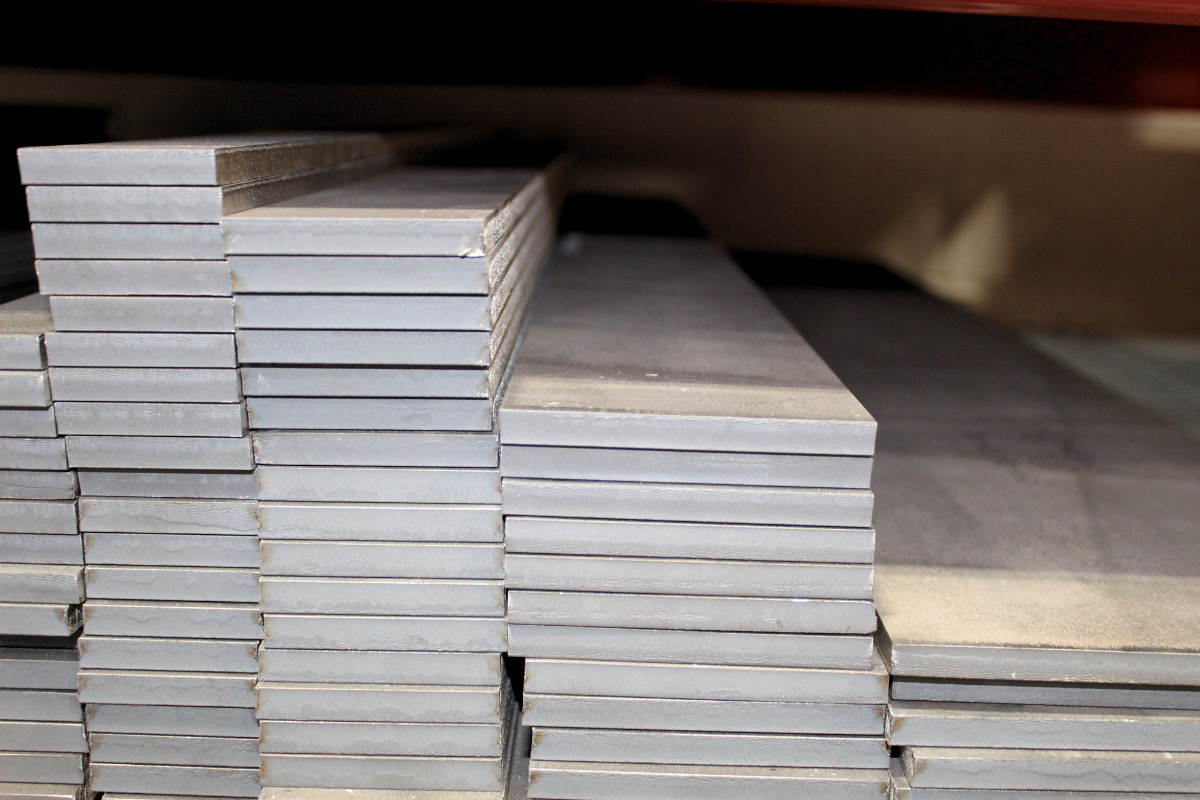
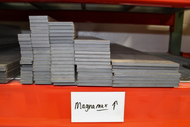
MagnaMax® strips cut to various sizes to support custom knife makers and production manufacturers.
Why Powder Metallurgy Changes Knife Steel Performance
Powder metallurgy creates much finer carbides than conventional steel processing. That finer structure improves toughness, wear resistance, and cutting performance.
Larrin used CPM 154 and conventional 154CM as an example. Both steels contain essentially the same chemical composition. The major difference comes from how the steel solidifies during manufacturing.
In conventional steel production, molten steel cools slowly inside a large mold. That slow cooling creates larger carbides and a coarser microstructure.
Powder metallurgy changes the process completely. Instead of cooling as one large ingot, molten steel sprays through a nozzle and rapidly solidifies into tiny powder particles. Each particle becomes a miniature steel ingot with a very fine structure.
Those powder particles later consolidate into finished steel while maintaining much smaller carbides.
That breakthrough allowed metallurgists to use higher vanadium levels without creating extremely brittle steels. Instead, powder metallurgy steels gained both wear resistance and toughness at the same time.
MagnaMax® uses this same principle to create its high-performance carbide structure.
Why MagnaMax® Improves Corrosion Resistance
MagnaMax® improves corrosion resistance by eliminating chromium carbides that reduce available chromium in the steel matrix.
Stainless steel resists corrosion because chromium forms a thin protective chromium oxide layer on the surface. That layer prevents rust from forming.
However, chromium carbides trap chromium inside brittle carbide particles. They also create chromium-depleted zones around those carbides. Those depleted areas become weak points where corrosion can begin.
Larrin explained that MagnaCut® and MagnaMax® avoid that issue by eliminating large chromium carbides entirely. As a result, more chromium remains available throughout the steel matrix to support corrosion resistance.
That design helps MagnaMax® maintain excellent corrosion resistance even while significantly increasing edge retention.
MagnaMax® vs Older High Wear Resistance Steels
MagnaMax® outperforms many older high wear resistance stainless steels by combining better toughness, corrosion resistance, and edge retention.
Larrin specifically compared MagnaMax® to M390, one of the most popular folding knife steels of the past decade. While M390 offered strong wear resistance and corrosion resistance, it relied heavily on large chromium carbides.
According to Larrin, MagnaMax® delivers:
- Better toughness
- Better corrosion resistance
- Better edge retention
He also noted that metallurgy tools and alloy design methods have improved dramatically since older steels like M390 were developed in the late 1980s.
That progress allowed the MagnaCut® family to push stainless knife steel performance further than previous generations.
The Future of the MagnaCut® Family
MagnaMax® represents another step forward in the MagnaCut® family of knife steels. It expands the original MagnaCut® concept into new performance ranges.
Larrin explained that MagnaCut® was always intended to become part of a larger family of alloys. MagnaMax® now gives knife users a different balance of properties focused more heavily on edge retention.
He also expressed excitement about seeing knife companies begin using MagnaMax® in production knives. After years of development and testing, the steel is finally reaching makers and buyers who want maximum cutting performance.
At the same time, Niagara Specialty Metals continues supporting knife manufacturers with specialized rolling expertise, technical support, and close collaboration throughout production.
Conclusion
MagnaMax® knife steel performance comes from a carefully engineered microstructure that improves edge retention, toughness, and corrosion resistance compared to older stainless steels. By eliminating large chromium carbides and using fine powder metallurgy carbides instead, MagnaMax® achieves one of the most advanced balances currently available in high-performance knife steel.
For knife makers and enthusiasts who want deeper insight into steel performance, MagnaMax® demonstrates how modern metallurgy continues pushing knife steel technology forward.
About the Guest
Dr. Larrin Thomas is a metallurgist, knife steel expert, and founder of Knife Steel Nerds. He developed MagnaCut® and MagnaMax® and is widely recognized for his work in knife steel metallurgy and performance testing.
Looking to learn more about MagnaMax® knife steel? Check out these related blogs:
MagnaMax Knife Steel Launching May 1st
MagnaMax Is Here: The Next Evolution in Knife Steel
How to Heat Treat MagnaMax Steel
For more information, check out our other blogs.
Click here to view our product catalog at our updated e-commerce store!
Interested in additional information on knife steel or CPM® MagnaCut stainless steels? Click here!