Knife Steel Performance Explained by Shawn Houston at ASM Buffalo
Apr 27th 2026
Knife Steel Performance: Shawn “Big Brown Bear” Houston Visits Niagara Specialty Metals and ASM Buffalo
Knife steel performance was the focus of a recent visit by Shawn “Big Brown Bear” Houston to Niagara Specialty Metals and his featured presentation at the ASM Buffalo Chapter on March 26th. The event highlighted how real-world testing reveals meaningful differences between modern particle metallurgy steels and traditional alloys.
For Niagara Specialty Metals, the visit was more than a technical discussion. It reinforced a growing partnership with one of the most respected voices in edge performance today. Shawn Houston, a custom knife maker, professional sharpener, and collaborator with industry leaders, brought a unique blend of hands-on experience and metallurgical insight to both the Niagara team and the broader ASM community.
In this post, we recap his visit, key takeaways from his presentation, and why his relationship with Niagara continues to matter for the future of high-performance steel.
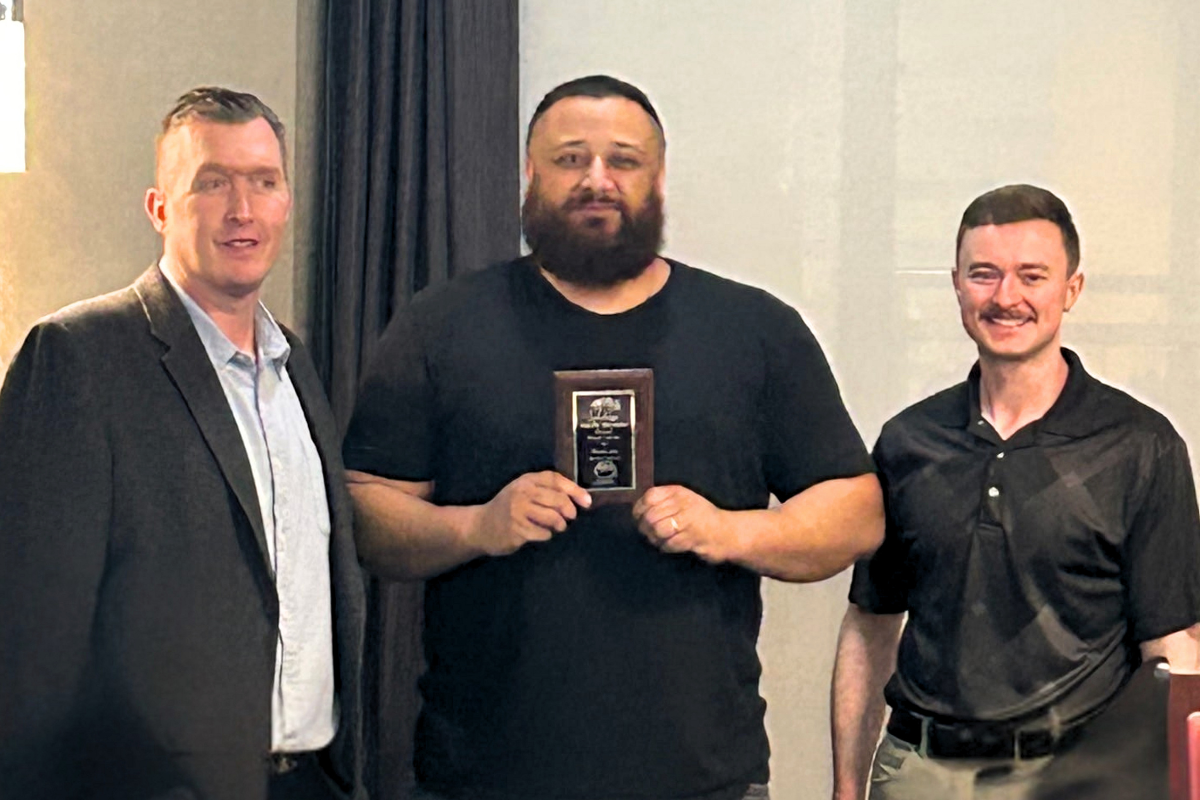
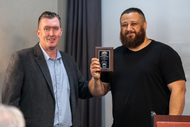
Niagara Specialty Metals employees Tim Gelnett and Justin Thomas, Co-Chairman of ASM Buffalo, with Shawn Houston at the ASM Buffalo event.
Understanding Real Knife Steel Performance
Real knife steel performance depends on what happens at the edge, not just what is listed on a datasheet. As Shawn explained during his presentation, “the most important part of the knife is the thing you can’t see.”
This creates a challenge for engineers, knife makers, and end users alike. Traditional testing methods such as CATRA and Charpy provide valuable controlled data. However, they do not always reflect how a knife performs in real-world conditions like hunting, food processing, or field use.
During his talk at the Buffalo Airport Hotel, part of the ASM Buffalo Chapter’s March 26th technical program, Shawn emphasized the importance of combining controlled testing with real-world application. Rope cutting, for example, simulates cutting animal hide and introduces a “mixed mode” of wear, stress, and edge failure.
Because of this, steel performance must be evaluated through both lenses. Controlled data shows potential. Real-world testing shows reality.
Takeaway: To truly understand knife steel performance, you must evaluate both lab results and how the edge behaves in real use.
Why Particle Metallurgy Steels Perform Differently
Particle metallurgy steel performance improves because it creates a more uniform microstructure at the edge. This was the central theme of Shawn Houston’s presentation and directly aligns with Niagara Specialty Metals’ expertise in processing advanced alloys.
In his comparison of MagnaMax® and 440C, Shawn demonstrated that PM steels produce finer, more evenly distributed carbides. In contrast, conventional ingot steels contain larger, elongated carbides that can lead to edge instability.
As a result, the differences show up clearly in testing:
- PM steels showed less edge chipping under stress
- Edges wore more evenly over time
- Higher hardness did not reduce toughness when structure was uniform
Even more compelling, Shawn’s rope cutting tests revealed that performance differences became more noticeable as cutting continued. After extended use, PM steel maintained a more consistent edge, while conventional steel showed greater degradation.
This insight connects directly to Niagara’s role in the supply chain. Niagara does not melt steel, but it plays a critical role in rolling and processing advanced materials into usable forms for knife makers and manufacturers. That processing must preserve the integrity of the steel’s microstructure to ensure real-world performance.
Takeaway: Particle metallurgy steels outperform traditional steels because their uniform structure leads to more consistent edge behavior and durability.
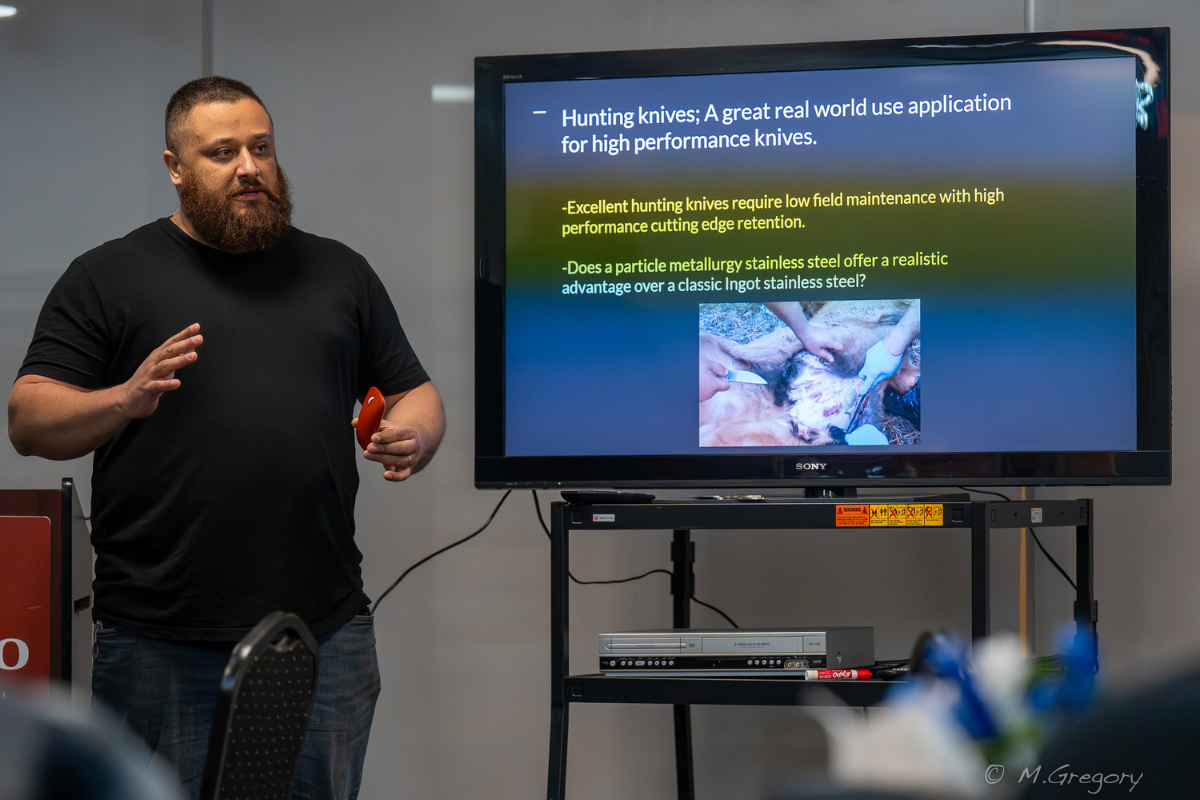
Shawn “Big Brown Bear” Houston presenting at the ASM Buffalo Chapter, sharing real-world insights on knife steel performance, particle metallurgy, and edge behavior.
Better Performance, Better Recovery, Stronger Partnership
Knife steel performance improves not only in use, but also in how the edge recovers after wear. One of the most surprising findings from Shawn’s testing was how PM steels responded to sharpening.
Despite higher hardness and more carbide volume, MagnaMax® returned to a sharper edge than 440C after minimal stropping. The uniform structure allowed the edge to refine more cleanly, while conventional steel retained micro-damage from carbide pullout.
This has real implications for users:
- Longer-lasting performance in the field
- Faster, more effective edge restoration
- Greater reliability under demanding conditions
Beyond the technical findings, Shawn’s visit to Niagara Specialty Metals strengthened an ongoing relationship built on shared values. Both Niagara and Shawn focus on performance, precision, and pushing the limits of what steel can do.
His time at Niagara included collaboration with the team, discussions around processing challenges, and a shared commitment to advancing knife steel performance. That partnership bridges the gap between metallurgical theory, manufacturing capability, and real-world application.
Takeaway: Modern PM steels deliver better performance and better recovery, and partnerships like the one between Shawn Houston and Niagara help bring those advantages to market.
Conclusion
Knife steel performance depends on edge behavior, real-world testing, and material consistency. Shawn Houston’s visit to Niagara Specialty Metals and his ASM presentation made one thing clear - the future of knife performance lies in understanding and optimizing what happens at the microscopic level.
By combining real-world testing with advanced materials, the industry continues to evolve. Niagara’s role in processing these steels, paired with experts like Shawn, ensures that innovation translates into real results for knife makers and end users.
As new alloys emerge and testing methods improve, one thing remains constant. Performance at the edge is what matters most.
About the Guest
Shawn “Big Brown Bear” Houston is a custom knife maker, professional sharpener, and metallography-focused researcher based in Sandy, Oregon. He has collaborated with industry leaders including Spyderco and Dr. Larrin Thomas of Knife Steel Nerds, bringing a data-driven approach to understanding edge performance.
Looking to learn more about knife steel performance, real-world testing, and how advanced materials are shaping the industry? Check out some of our related blogs here:
High-Performance Powder Metallurgy Knife Steel for Precision Blades
High-Performance Knife Steel Explained
MagnaCut steel production update: what knife makers need to know
For more information, check out our other blogs.
Click here to view our product catalog at our updated e-commerce store!
Interested in additional information on knife steel or CPM® MagnaCut stainless steels? Click here!