
Knife Making Supply Chain: How Strong Partnerships Build Better Blades
Aug 31st 2026
How Strong Partnerships Build Better Blades in the Knife Making Supply Chain
The knife making supply chain plays a major role in the quality, consistency, and performance of a finished blade. While many makers focus on steel selection and blade design, the suppliers and service providers behind the scenes often have a significant impact on the final result.
During a recent discussion between Niagara Specialty Metals and Peters’ Heat Treating Inc., Andrew Wilkosz and Trevor Kaplin shared their perspectives on how collaboration helps knife makers achieve better outcomes. From material selection and laser cutting to heat treatment and quality control, each step builds upon the one before it.
Understanding how these relationships work can help makers reduce mistakes, improve efficiency, and create better knives.
Quick Answer
A strong knife making supply chain combines reliable steel suppliers, precision processing, and experienced heat treatment partners. When each company communicates effectively and understands the customer's goals, knife makers benefit from better quality, faster turnaround times, reduced handling, and more consistent results.
Why the Knife Making Supply Chain Starts with Quality Materials
Every successful knife begins with reliable material.
Trevor Kaplan explained that one of the most common situations he encounters is customers who are unsure where their steel originated. Some makers simply send a finished blade and ask if it can be hardened. However, quality heat treatment starts long before a blade enters a furnace.
According to Trevor, makers should purchase material from reliable suppliers that provide consistent quality and proper documentation. The steel becomes the foundation for every process that follows. If problems exist at the material stage, they can create challenges throughout manufacturing.
This is particularly important with premium knife steels such as CPM® MagnaCut and MagnaMax™, where chemistry, cleanliness, and consistency contribute directly to final performance.
The practical takeaway is simple. Before focusing on heat treatment, grinding, or finishing, make sure the material source is trustworthy and consistent.
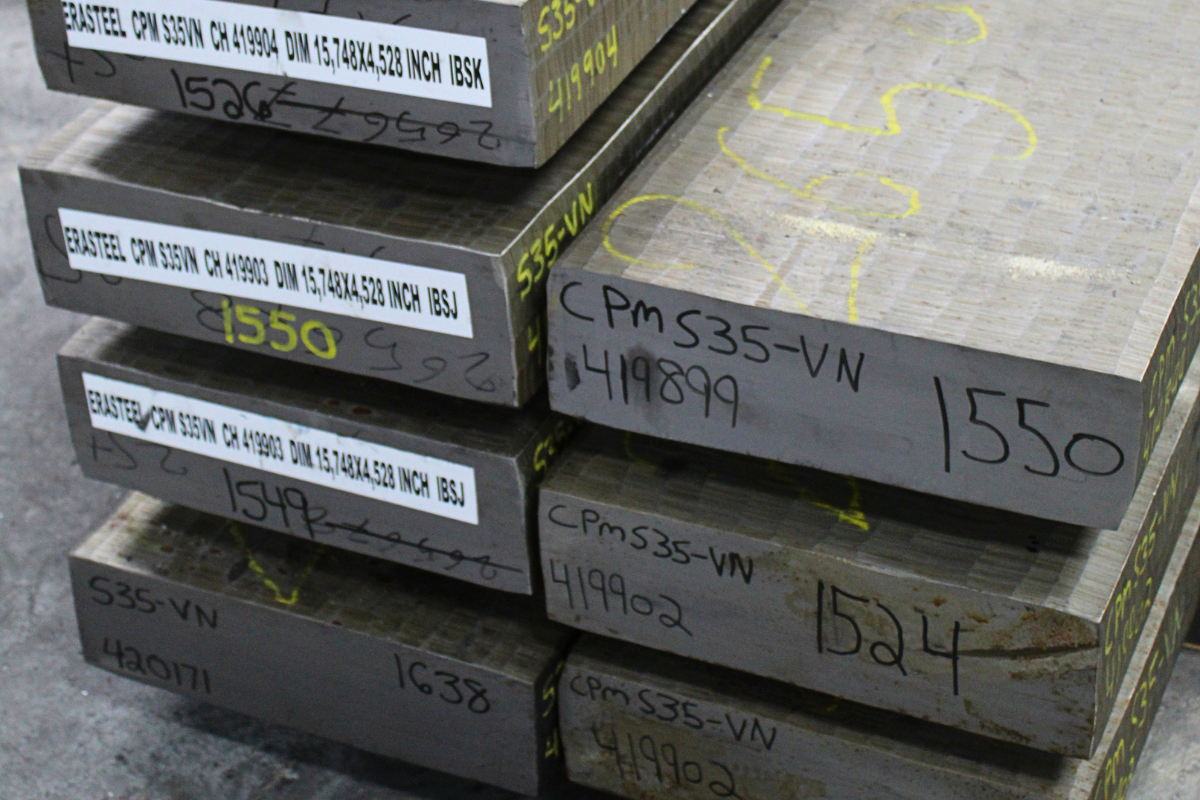
Quality knives begin with quality materials. Premium steels like Erasteel S35VN provide the foundation for successful processing, heat treatment, and finished blade performance throughout the knife making supply chain.
Why Communication Creates Better Results
Clear communication often determines whether a project succeeds or struggles.
Andrew Wilkosz emphasized that communication may be one of the biggest challenges in manufacturing. Customers, suppliers, and processors all need a shared understanding of expectations before production begins.
A prototype run may require a different approach than a production run of thousands of parts. Likewise, unusual alloys, unique geometries, or specific hardness requirements can influence processing decisions.
Andrew explained that Peters’ focuses on becoming a solution provider rather than simply a service provider. The more information customers share early in the process, the easier it becomes to recommend the right approach.
This philosophy aligns closely with how Niagara Specialty Metals works with customers. Material recommendations, sizing requirements, processing considerations, and manufacturing goals all benefit from open communication.
Strong partnerships begin with strong conversations.
How Collaboration Reduces Time, Cost, and Handling
The most efficient knife making supply chain eliminates unnecessary steps.
During the interview, Trevor highlighted one of the biggest advantages available to knife makers today. Niagara Specialty Metals can supply material, laser cut blanks, and coordinate shipment directly to Peters’ Heat Treating before the customer ever receives the parts.
This streamlined workflow reduces handling and transportation between multiple vendors. As a result, makers can often reduce lead times while simplifying project management.
Trevor noted that this approach creates meaningful savings throughout the supply chain. Fewer shipments mean lower transportation costs. Fewer touch points mean fewer opportunities for delays or errors.
For knife makers, especially small businesses and growing manufacturers, these efficiencies can free up valuable time that can be spent designing, grinding, assembling, and selling knives.
The result is a process that moves material more efficiently from raw steel to finished blade.
Why Specialized Partners Improve Consistency
Specialized companies bring expertise that would be difficult for most makers to develop internally.
Peters’ Heat Treating processes hundreds of unique orders every week across industries including aerospace, automotive, tooling, and cutlery. This broad experience allows the company to apply lessons learned across multiple markets.
Andrew described Peters’ as "hyper diversified." That diversity gives the company access to a unique set of knowledge and data that can help solve complex manufacturing challenges.
The blade division itself specializes exclusively in knife processing. Trevor noted that several members of the team are knife makers themselves, allowing them to understand customer concerns from both sides of the process.
This specialization extends beyond personnel. Peters’ maintains extensive documentation, material review procedures, and process controls that help create repeatable results.
When knife makers partner with specialists, they gain access to knowledge, equipment, and experience that would otherwise require significant investment to develop independently.
Why American Manufacturing Partnerships Continue to Matter
Strong domestic partnerships strengthen the entire manufacturing ecosystem.
Both Niagara Specialty Metals and Peters’ Heat Treating emphasized the importance of supporting American manufacturing. While their businesses serve different functions, both organizations share a common goal of helping customers succeed through reliable domestic production.
Andrew explained that Peters’ still operates under many of the same principles established when Doug Peters founded the company in 1979. One of those principles is becoming a seamless extension of the customer's operation.
That mindset creates long-term relationships rather than transactional interactions.
When steel suppliers, processors, and manufacturers work together, they can solve problems faster, improve product quality, and respond more effectively to customer needs.
For knife makers, those relationships often become a competitive advantage.
Conclusion
The knife making supply chain is much more than a series of independent transactions. It is a network of partnerships that influences every stage of production, from raw material selection to final blade performance.
The discussion between Niagara Specialty Metals and Peters’ Heat Treating highlights the value of communication, specialization, and collaboration throughout the manufacturing process. Reliable material sourcing, precision processing, and professional heat treatment all contribute to a better finished product.
For knife makers, choosing the right partners can simplify operations, reduce lead times, improve consistency, and ultimately help create better knives.
About the Guests
Trevor Kaplin serves as Blade Division Manager at Peters’ Heat Treating Inc. and has worked with the company for nearly eight years. He specializes in cutlery heat treatment and oversees blade processing operations.
Andrew Wilkosz is the President/ Owner of Peters’ Heat Treating Inc. and represents the second generation of family leadership within the company. He works across multiple industries, including aerospace, automotive, tooling, and cutlery thermal processing.
Looking to learn more about industry relationships with Niagara Specialty Metals? Check out some of our related blogs here:
Niagara Specialty Metals Knife Steel Collaboration with Larrin Thomas: What It Means for Makers
Erasteel Niagara Partnership: Forged in Precision
Peters’ Heat Treating: From a Small Garage Shop to a World-Class Thermal Processor
For more information, check out our other blogs.
Click here to view our product catalog at our updated e-commerce store!
Interested in additional information on knife steel or CPM® MagnaCut stainless steels? Click here!