

CPM® REX76 PM High Speed Steel
Industries: Industrial
- CPM® high speed powder metal steel
- Designed to cut materials at high speed despite the extreme heat generated at the tool's cutting edge
- Broaches, end mill, gear hobs, spade drills, taps, and form tools
- ASTM A600
For a data sheet on CPM® REX76 PM High Speed Steel, please click here.
CPM® REX76 PM high speed steel is designed for extreme cutting speeds and superior heat resistance in tooling.
Hot rolled & processed by the employee owners of Niagara Specialty Metals in Akron NY
- Take a virtual tour of Niagara Specialty Metals. Click here to watch the full plant tour on YouTube.
- Learn more about our Specialty Metals for Industrial Applications. Click here to explore the full range of industrial metal grades we supply.
Ordering Details:
- Not available online
- Call 1-800-424-0048 or email ([email protected]) for pricing
CPM® REX76 PM High Speed Steel Data Sheet
| C | Mn | Si | Cr | W | Mo | V | Co |
|---|---|---|---|---|---|---|---|
| 1.50 | 0.30 | 0.30 | 3.75 | 9.75 | 5.25 | 3.10 | 8.50 |
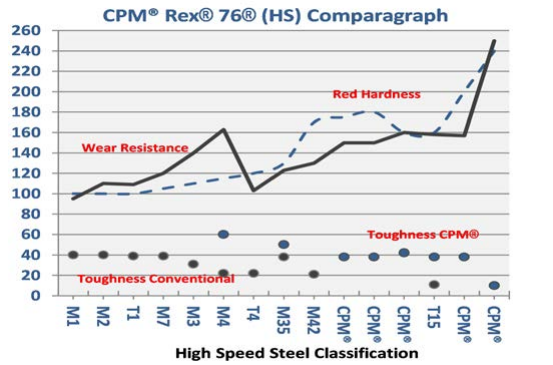
CPM® REX76 is a super high speed steel made by the CPM® process. It is heat treatable to HRC 68–70. Its high carbon, vanadium and cobalt contents provide abrasion resistance comparable to that of T15 and red hardness superior to that of M42. With its high hardness, fine grain size and uniform carbide distribution, CPM® REX76 is an outstanding choice for special purpose cutting tools requiring high red hardness, high abrasion resistance, and good toughness.
The CPM® process results in a homogeneous microstructure with a finer, more uniform carbide distribution imparting superior dimensional stability, grindability and toughness when compared to steels produced by conventional processes. The CPM® process also allows the design of more highly alloyed grades which cannot be produced by conventional steelmaking.
Typical Applications: End mills, form tools, shaper cutters, gear nobs, broaches, spade drills, tool bits, milling cutters, and special taps.
Note: These are some typical applications. Your specific application should not be undertaken without independent study and evaluation for suitability.

CPM® Steel

Conventional Steel
Machinability in the annealed condition is approximately 15% of W1 Tool Steel (1%C).
Grindability of CPM® REX76 compares favorably with regular high-speed steels because of the fine, uniformly distributed carbides. Conventional grinding wheels designed for high-speed steels can be used. In special cases, the advice of a grinding wheel manufacturer should be sought.
Surface Treatments
CPM® REX76 can be nitrided or PVD coated if desired. If a CVD treatment is used, subsequent hardening is required and may result in undesirable distortion.
Thermal Treatments
Critical Temperature: 1535°F (835°C).
Forging: 2000–2100°F (1095–1150°C). Do not forge below 1700°F (925°C). Slow cool after forging.
Annealing
Heat to 1600°F (870°C), hold 2 hours, slow cool no faster than 25°F (15°C) per hour to 1000°F (540°C), then furnace cool or cool in still air to room temperature.
Annealed Hardness: Approx. BHN 285/311.
Stress Relieving
Annealed parts: Heat to 1100–1300°F (595–705°C), hold 2 hours, then furnace cool or cool in still air.
Hardened parts: Heat to 25°F (15°C) below original tempering temperature, or 1000°F (540°C) minimum, hold 2 hours, then furnace cool or cool in still air.
Hardening (Salt or High Pressure Vacuum preferred)
Pre–heat: Heat to 1500–1550°F (815–845°C), hold long enough to soak through. For vacuum heat treating, an additional pre–heat at 1850–1900°F (1010–1040°C) is recommended to minimize hold time needed at austenitizing temperature.
Austenitize: 2100–2190°F (1150–1200°C).
Standard recommendation to achieve HRC 67–69 is 2150–2175°F (1175–1190°C).
Quench: Quench rapidly to below 1100°F (595°C), equalize, then air cool to hand warm, below 125°F (50°C). Salt or interrupted oil quenching usually gives the best heat treat
response for high speed steels. A fast quench rate from hardening temperature to below 1100°F (595°C) is critical to achieve optimum heat treat response.
Temper: 1000°F (540°C) minimum. Triple or quadruple tempering required, hold 2 hour minimum at temperature. Cool to room temperature between tempers.
Straightening: Best done warm 400°F minimum (205°C). Straightening after salt quenching and before cooling to below 400°F (205°C) is preferred.
Size Change During Hardening
| Hardening Temperature | Tempering Temperature | HRC | Longitudinal Size Change |
|---|---|---|---|
| 2175°F (1190°C) | 1025°F (550°C) | 68.5 | +0.22% |
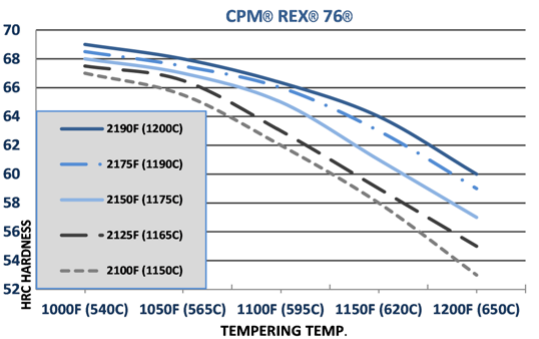
| Heat Treat Response - (HRC) Oil or Salt Quench | |||||
|---|---|---|---|---|---|
| Tempering Temp. | 2100°F (1150°C) | 2125°F (1150°C) | 2150°F (1175°C) | 2175°F (1190°C) | 2190°F (1200°C) |
| As Quenched | 68 | 68 | 67 | 66.5 | 66.5 |
| 1000°F (540°C) | 67 | 67.5 | 68 | 68.5 | 69 |
| 1025°F (550°C) | 66.5 | 67 | 67.5 | 68 | 68.5 |
| 1050°F (565°C) | 65.5 | 66.5 | 67 | 67.5 | 68 |
| 1100°F (595°C) | 63 | 64 | 65 | 66 | 66.5 |
| 1150°F (620°C) | 59 | 60 | 61.5 | 63 | 64 |
| 1200°F (650°C) | 53 | 55 | 57 | 59 | 60 |
| Minimum Time at Aust. Temp. | 10 minutes | 10 minutes | 5 minutes | 5 minutes | 3 minutes |
| Minimum Number of Tempers | 3 | 3 | 3 | 4 | 4 |
This data sheet is for informational purposes only. Alloy characteristics are subject to change due to chemical composition and/or processing. We do not certify the material’s suitability for specific applications.