MagnaMax Steel Performance, Applications, and Heat Treatment
Sep 21st 2026
MagnaMax® is a powder metallurgy stainless steel designed for enhanced wear resistance while maintaining excellent hardness and corrosion resistance. It belongs to the same family as CPM® MagnaCut but targets a different balance of properties.
Its microstructure uses small vanadium and niobium carbides rather than larger chromium carbides. This microstructure contributes to a combination of wear resistance and toughness that distinguishes MagnaMax® from previous high-wear stainless steels.
For knife makers and manufacturers considering MagnaMax®, understanding this balance is only part of the equation. Proper heat treatment also plays an important role in achieving the desired properties.
Here is what knife makers and manufacturers should know about MagnaMax® performance, applications, microstructure, and recommended heat treatment.
Download the MagnaMax® data sheet.
What Is MagnaMax® Steel?
MagnaMax® is a powder metallurgy stainless steel in the same family as CPM® MagnaCut, but it is designed for enhanced wear resistance.
MagnaMax® has wear resistance comparable to CPM® S90V and CPM® S110V. However, MagnaMax® achieves significantly improved toughness compared with those grades through a microstructure containing only small vanadium and niobium carbides rather than larger chromium carbides.
That microstructure is an important part of the MagnaMax® performance story.
The micrographs below visually compare MagnaMax® with M390. They show the difference between the carbide structures of the two materials. The accompanying performance chart also places MagnaMax® among previous high-wear stainless steels based on toughness and CATRA edge retention.
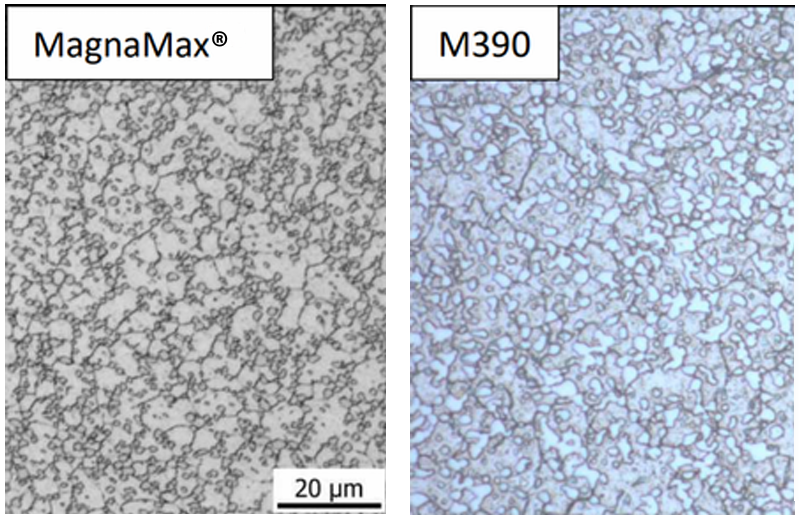
MagnaMax® uses a microstructure of small vanadium and niobium carbides rather than the larger chromium carbides found in M390.
MagnaMax® offers a toughness-to-wear-resistance balance similar to high-wear, non-stainless powder metallurgy steels, including K390 and CPM® 10V.
It also offers both better wear resistance and toughness than M390 due to its microstructure.
How Does MagnaMax® Balance Wear Resistance and Toughness?
MagnaMax® combines high wear resistance with significantly improved toughness compared with CPM® S90V and CPM® S110V.
Wear resistance can be especially important in applications where maintaining cutting performance is a priority. However, wear resistance is only one part of the MagnaMax® performance profile.
Instead, the grade was developed around a balance of properties.
The chart below compares toughness with CATRA edge retention for several stainless steels. MagnaMax® appears at a similar CATRA edge-retention level to CPM® S90V and CPM® S110V while plotting at a higher toughness level.
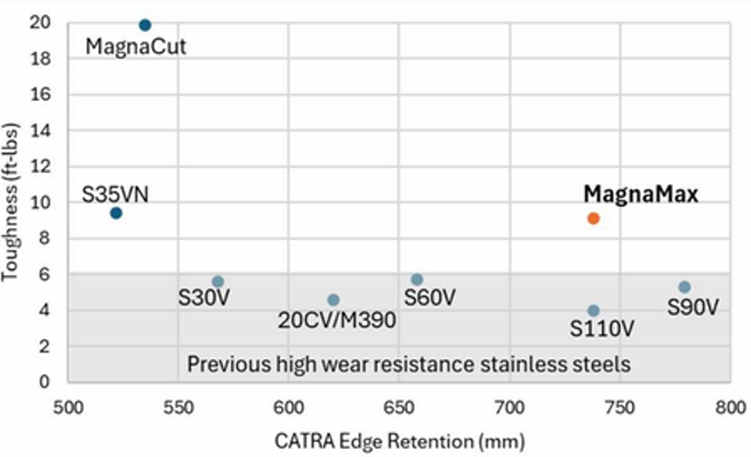
MagnaMax® combines CATRA edge retention comparable to CPM® S90V and CPM® S110V with higher toughness in this comparison.
This balance is tied to MagnaMax®'s small vanadium and niobium carbides.
The result is a stainless powder metallurgy steel designed to provide high wear resistance without giving up the level of toughness associated with previous high-wear stainless options.
For knife makers, this provides another performance balance to consider when selecting a material for a particular design.
How Does MagnaMax® Approach Corrosion Resistance?
MagnaMax® is designed to provide excellent corrosion resistance while maintaining its combination of wear resistance, toughness, and hardness.
MagnaMax® offers improved corrosion resistance relative to CPM® S90V, CPM® S110V, and M390.
The reason again comes back to microstructure.
MagnaMax® does not contain chromium carbides, which can act as sites where corrosion begins. Instead, its carbide structure consists of small vanadium and niobium carbides.
This allows the grade to pursue high wear resistance without relying on the larger chromium carbides found in some other high-wear stainless steels.
The combination helps explain why MagnaMax® is positioned as more than simply a wear-resistant steel. Its performance profile includes wear resistance, toughness, hardness, and corrosion resistance.
What Is MagnaMax® Used For?
MagnaMax® is designed for specialty cutlery as well as a wide range of industrial wear applications.
For cutlery, typical applications include handmade knives and high-end factory knives.
However, MagnaMax® is not limited to knife blades.
The listed applications also include:
- Plastic injection and extrusion feed screws
- Non-return valve components
- Pelletizing equipment
- Gate and nozzle inserts
- Industrial knives
- Slitters and cutters
- Injection molds and inserts
- Wear components for food and chemical processing
- Bearings
- Bushings
- Valves
- Rolls
- Gear pumps
These applications reflect the broader combination of properties MagnaMax® was designed to provide.
From specialty cutlery to industrial wear components, MagnaMax® is intended for applications that can benefit from its combination of wear resistance, toughness, hardness, and corrosion resistance.
What Is the Recommended Heat Treatment for MagnaMax®?
For balanced properties, the MagnaMax® data sheet recommends a 2150°F (1175°C) austenitizing temperature when using cryogenic treatment.
The preferred process uses austenitizing temperatures between 2100°F and 2250°F, with 2150°F recommended. Soak time ranges from 5 to 20 minutes depending on temperature.
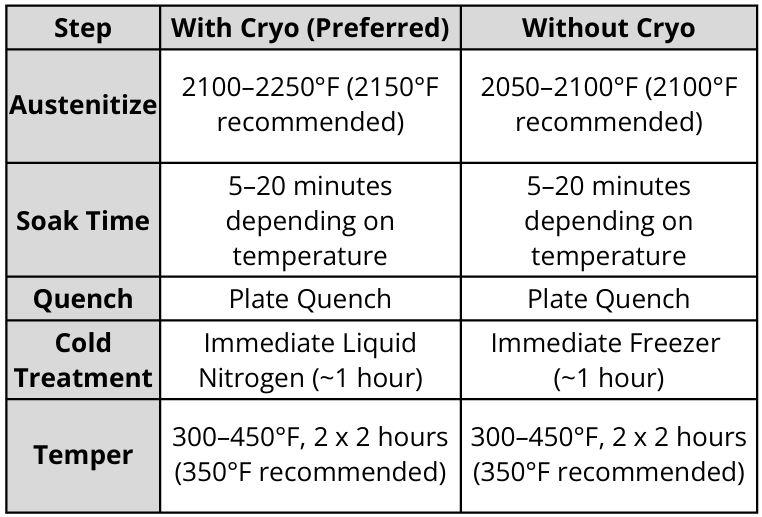
Recommended MagnaMax® heat treatment paths with cryogenic treatment and without cryogenic treatment.
After austenitizing, the preferred process calls for a plate quench followed by immediate liquid-nitrogen treatment for approximately one hour.
The best properties are achieved when using cryogenic treatment.
For tempering, the recommended range is 300°F to 450°F, using two two-hour tempering cycles. A tempering temperature of 350°F (175°C) is recommended for balanced properties. A 300°F temper maximizes hardness, while 450°F offers greater toughness with somewhat reduced hardness.
Alternative recommendations are available when liquid-nitrogen cryogenic treatment is unavailable.
When using a freezer or dry-ice treatment, it recommends 2100°F (1150°C). If no cold treatment is available, the recommendation drops to 2050°F (1120°C).
How Do Austenitizing Temperature and Cold Treatment Affect MagnaMax®?
Cold treatment can decrease retained austenite and increase the hardness of MagnaMax®, with lower treatment temperatures providing greater effectiveness.
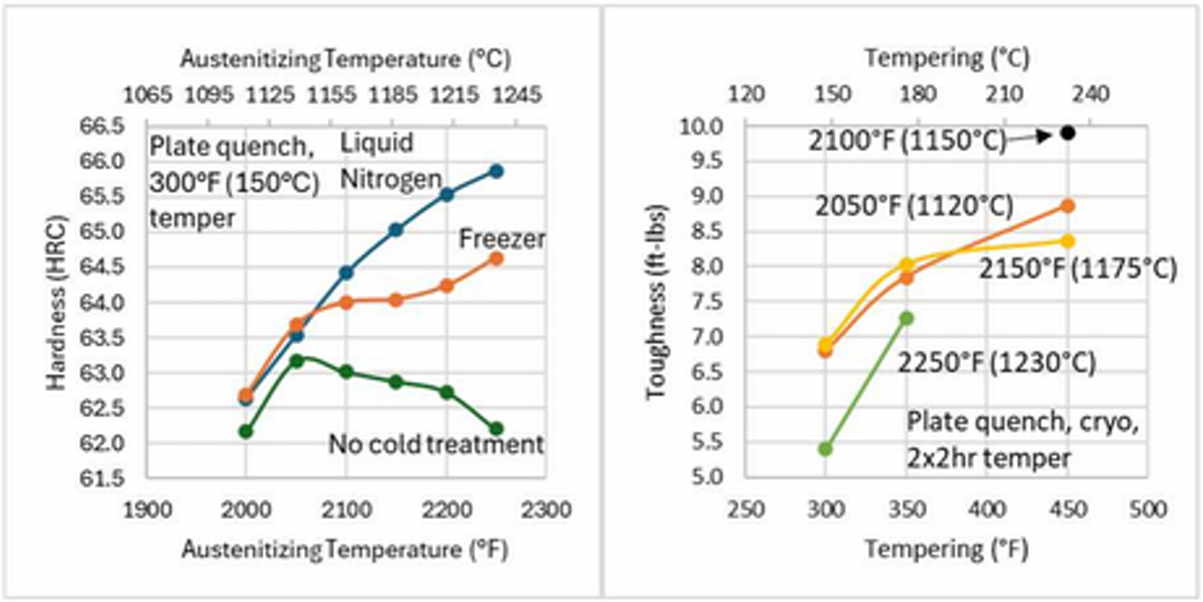
MagnaMax® hardness and toughness change with austenitizing temperature, cold treatment, and tempering temperature.
Tempering before cold treatment reduces its effectiveness. However, tempering first also decreases the chance of warping or cracking.
Austenitizing time also changes with temperature. The recommended minimum hold times are:
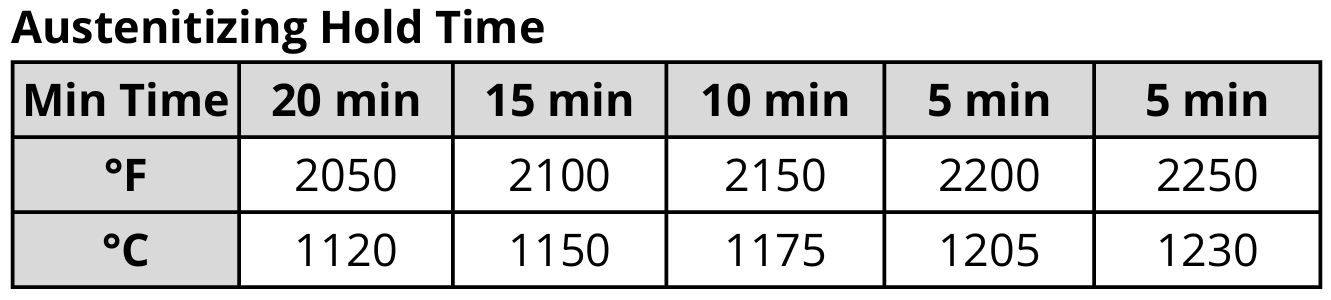
Minimum austenitizing hold times decrease as temperature increases, from 20 minutes at 2050°F to 5 minutes at 2200°F and 2250°F.
Thick cross sections and larger pieces may require longer austenitizing times.
Quenching options include plate, oil, air, or gas quenching at a minimum of 2 bar to below 125°F (50°C). Salt or interrupted oil quenching to approximately 1000°F (540°C), followed by air cooling below 125°F, is also listed.
One important caution is that tempering above 750°F (400°C) decreases corrosion resistance.
What Other Thermal Treatments Are Recommended?
MagnaMax® also has specific recommendations for forging, annealing, stress relieving, and straightening.
For forging, the listed temperature is 2100°F (1150°C), with instructions not to forge below 1750°F (950°C).
For annealing, heat the material to 1650°F (900°C), hold for two hours, and slow cool at 25°F (15°C) per hour to 1100°F (595°C). The material can then be furnace cooled or cooled in still air to room temperature.
The listed annealed hardness is 32 HRC, or approximately 300 BHN.
For annealed parts requiring stress relief, the recommended temperature range is 1100°F to 1300°F (595°C to 705°C), held for two hours before furnace cooling or cooling in still air.
For hardened parts, stress relieving should occur 25°F to 50°F (15°C to 30°C) below the original tempering temperature for two hours.
Finally, straightening is best performed warm, between 400°F and 800°F (200°C to 425°C).
Understanding the MagnaMax® Performance Balance
MagnaMax® was designed to combine high wear resistance with toughness, hardness, and corrosion resistance in a powder metallurgy stainless steel.
Its wear resistance is comparable to CPM® S90V and CPM® S110V, while its small vanadium and niobium carbide microstructure provides significantly improved toughness compared with those grades.
The same microstructure also contributes to its corrosion resistance.
For users seeking balanced properties during heat treatment, Niagara Specialty Metals recommends 2150°F with cryogenic treatment and a 350°F temper. Alternative recommendations are available for freezer, dry-ice, or no-cold-treatment processes.
Ultimately, the appropriate material and heat treatment depend on the requirements of the application. The MagnaMax® data sheet is intended for informational purposes, and alloy characteristics can change based on chemical composition and processing. Niagara Specialty Metals does not certify the material's suitability for specific applications.
Looking to learn more about MagnaMax®? Check out these related blogs:
How to Heat Treat MagnaMax Steel
MagnaMax Steel Performance Explained
What Makes MagnaMax Knife Blade Steel Different
For more information, check out our other blogs.
Click here to view our product catalog at our updated e-commerce store!
Interested in additional information on knife steel or CPM® MagnaCut stainless steels? Click here!