

CPM® 4V PM Tool Steel
Industries: Cutlery & Knives / Industrial
- CPM® alloy that exhibits high toughness and heat resistance
- Cutlery, stamping & forming tools, dies, scrap choppers, fine blanking tools, and planer blades coining dies
- ASTM A681
- Manufactured in the USA
For a data sheet on CPM® 4V PM Tool Steel, please click here
Tolerance and Finish
Material is sandblasted to a gray matte finish.
The thickness and width are supplied oversize to finish at the requested dimension.
Cutting Methods
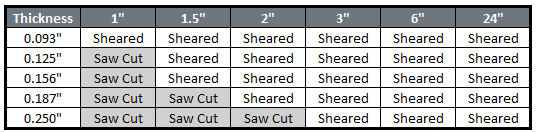
All orders will be sheared to size unless the width is too narrow.
$100 minimum per order please.
All dimensions are in inches.
The length can range from 35-1/2 to 38 inches.
The width for 24" sheets can range from 23 to 25 inches.
CPM® 4V PM tool steel combines high toughness and wear resistance for demanding industrial tooling and forming applications.
Hot rolled & processed by the employee owners of Niagara Specialty Metals in Akron NY
- Take a virtual tour of Niagara Specialty Metals. Click here to watch the full plant tour on YouTube.
- Learn more about our Specialty Metals for Cutlery and Knives. Click here to explore the full range of knife steels we supply.
- Learn more about our Specialty Metals for Industrial Applications. Click here to explore the full range of industrial metal grades we supply.
Cut Method by Thickness / Width
| Surface Finish | Descaled |
|---|---|
| Width | 1", 1.5", 2", 3", 6", 24" |
| Thickness: .103/.113 thick will finish at | .093" thick |
| Thickness: .140/.156 thick will finish at | .125” thick |
| Thickness: .172/.188 thick will finish at | .156” thick |
| Thickness: .207/.227 thick will finish at | .187” thick |
| Thickness: .275/.300 thick will finish at | .250” thick |
| Length can range from | 35 1/2" to 38" |
CPM® 4V PM Tool Steel Data Sheet
Typical Composition
| C | Mn | Si | Cr | Mo | V |
|---|---|---|---|---|---|
| 1.35 | 0.40 | 0.80 | 5.00 | 2.95 | 3.85 |
CPM® 4V is a powder tool steel designed as an upgrade for CPM® 3V for the blanking and advanced high strength steel applications. The goal was to design an alloy with high impact toughness and more wear resistance than currently available with CPM® 3V. Knife makers have often regarded CPM® 3V as a great heavy duty knife material and CPM® 4V will be an improvement for those who need more wear resistance. Intended to be used at HRC 62–64. CPM® 4V should be used in CPM® 3V applications that require more wear resistance.
Typical Applications: Powder compaction tooling, fine blanking tools, stamping or forming tools, and advanced high strength steel applications.
Mechanical Properties
Impact Toughness
The CPM® microstructure gives CPM® 4V its high impact toughness which approaches that of the shock resistant tool steels.
Relative Mechanical Properties
The combination of wear resistance and toughness of CPM® 4V makes it an excellent alternative to some other tool steel due to its high impact toughness and high range of wear resistance.
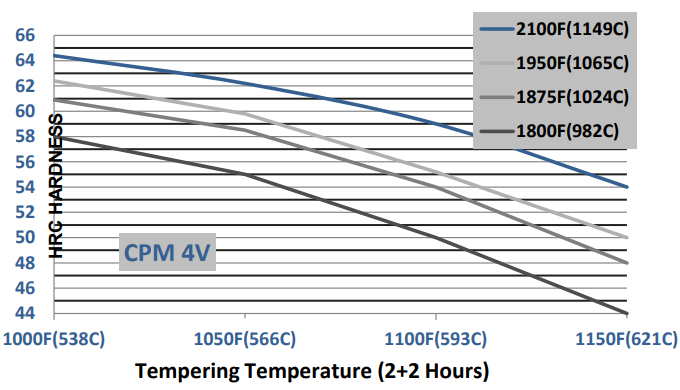
| Heat Treat Response (HRC Hardness) | ||||
|---|---|---|---|---|
| Austenitizing Temperature | ||||
| Tempering Temp | 1800°F (982°C) | 1875°F (1024°C) | 1950°F (1065°C) | 2100°F (1149°C) |
| Minimum Time | 30 Min | 30 Min | 30 Min | 15 Min |
| 1000°F (540°C) | 58 | 61 | 62.5 | 64.5 |
| 1050°F (565°C) | 55 | 58.5 | 59.5 | 63 |
| 1100°F (593°C) | 50 | 54 | 55.5 | 59 |
| 1150°F (621°C) | 44 | 48 | 50 | 54 |
| Minimum Tempers | 2 | 2 | 2 | 2 |
Thermal Treatments
Hardening Preheat: Heat to 1500–1550°F (816–845°C), equalize.
Austenitize: Following preheat heat material rapidly.
Quench: Air or positive pressure quench (4 bar minimum), or oil quench (black) to about 900°F (482°C), then air cool to 150°F – 125°F (66°C – 51°C). Salt bath treatment, if practical, will ensure the maximum attainable toughness for a given hardening treatment. Salt quench at 1000°F–1100°F (538°C–593°C), equalize, then air cool to 150°F–125°F (66°C–51°C).
Temper: Immediately after quenching, temper three times (two times minimum) at 1000–1100°F (538–593°C). Hold at temperature for 1 hour per inch of thickness, 2 hours minimum, then air cool. Do not temper below 1000°F (538°C).
Recommended Heat Treatment: For the best combination of toughness and wear resistance, austenitize (furnace or salt bath) at 1875–1950°F (1024–1065°C), soak 30 minutes, and quench. Temper 3 times at 1000°F (538°C). For maximum wear resistance austenitize (furnace or salt bath) at 2100°F (1149°C), soak 15 minutes, and quench. For maximum toughness austenitize (furnace or salt bath) at 1800°F (982°C), soak 30 minutes, and quench.
Aim hardness: HRC 62–64. Higher austenitizing temperatures can be used to obtain higher hardness, at a slight decrease in impact resistance. The lower austenitizing temperatures provide the best impact toughness.
Annealing
Annealing must be performed after hot working and before rehardening. Heat at a rate no higher than 400°F (222°C) per hour to 1600–1650°F (871–899°C). Hold at temperature for 1 hour per inch of thickness, 2 hours minimum. Cool slowly with the furnace at a rate no higher than 50°F (28°C) to 1000°F (649°C), until cooled to ambient temperature, in the furnace or in air.
This data sheet is for informational purposes only. Alloy characteristics are subject to change due to chemical composition and/or processing. We do not certify the material’s suitability for specific applications.