

D-2 Cold Work Tool Steel
Industries: Cutlery & Knives
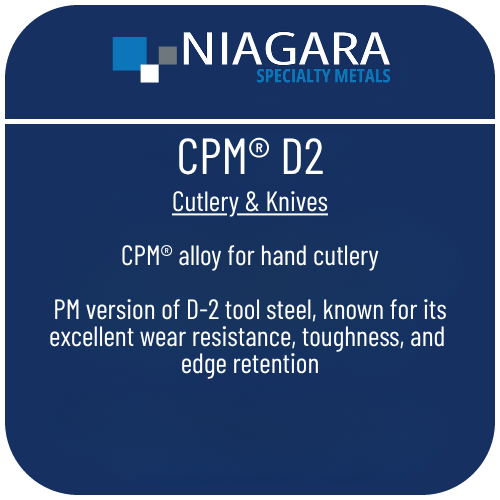
- Air melt, lower cost alloy for hand cutlery
- Our air melt cutlery grade has a long history or high performance in the knife industry
- They are more affordable for the everyday knife enthusiast
- Manufactured in the USA
For a data sheet on D-2 Cold Work Tool Steel, please click here
Tolerance and Finish
Material is sandblasted to a gray matte finish.
The thickness and width are supplied oversize to finish at the requested dimension.
Cutting Methods
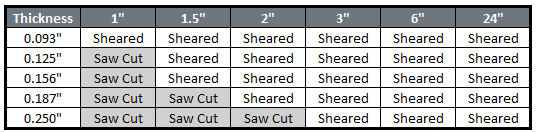
All orders will be sheared to size unless the width is too narrow.
$100 minimum per order please.
All dimensions are in inches.
The length can range from 35-1/2 to 38 inches.
The width for 24" sheets can range from 23 to 25 inches.
D-2 cold work tool steel provides strong wear resistance and dimensional stability for dies, punches, and tooling. Upgrade your tools today!
Hot rolled & processed by the employee owners of Niagara Specialty Metals in Akron NY
- Take a virtual tour of Niagara Specialty Metals. Click here to watch the full plant tour on YouTube.
- Learn more about our Specialty Metals for Cutlery and Knives. Click here to explore the full range of knife steels we supply.
Cut Method by Thickness / Width
| Surface Finish | Descaled |
|---|---|
| Width | 1", 1.5", 2", 3", 6", 24" |
| Thickness: .103/.113 thick will finish at | .093" thick |
| Thickness: .140/.156 thick will finish at | .125” thick |
| Thickness: .172/.188 thick will finish at | .156” thick |
| Thickness: .207/.227 thick will finish at | .187” thick |
| Thickness: .275/.300 thick will finish at | .250” thick |
| Length can range from | 35 1/2" to 38" |
D-2 Cold Work Tool Steel Data Sheet
Typical Composition
| C | Cr | Mo | V |
|---|---|---|---|
| 1.42 | 11.50 | 0.90 | 0.80 |
D–2 is an air–hardening, high carbon, high chromium tool steel, heat treatable to HRC 60–62. It offers excellent abrasion resistance, due to a large volume of carbides in the microstructure. D–2 has been widely used for many years in cold work applications requiring very high wear resistance. It is machinable in the annealed condition and like other air–hardening tool steels, exhibits minimal distortion on hardening.
Typical Applications: Stamping or forming dies, punches and dies, forming rolls, blanking dies, thread rolling dies, coining dies, lamination dies, trim dies, industrial knives and slitters, shear blades, fine blanking tools, scrap choppers, wear parts, tire shredders, and plastic injection feed screws and tips.
Mechanical Properties
| Grade | Heat Treatment Austenitizing Temperature |
HRC | Impact Toughness (ft.lb.) | Impact Toughness (J) | Wear Resistance Adhesive |
|---|---|---|---|---|---|
| D-2 | 1850°F (1010°C) | 60 | 21 | 28 | 3–4 |
| S-7 | 1750°F (955°C) | 57 | 125 | 165 | 1 |
| A-2 | 1750°F (955°C) | 60 | 40 | 53 | 2–3 |
| CRU-WEAR® | 1950°F (1065°C) | 62 | 30 | 40 | 5–6 |
| CPM® 3V | 1950°F (1065°C) | 60 | 70 | 95 | 7 |
| M-2 | 2050°F (1120°C) | 62 | 20 | 27 | 8–10 |
| M-4 | 2050°F (1120°C) | 62 | 32 | 43 | 20–25 |
| CPM® 10V | 2150°F (1175°C) | 63 | 14 | 19 | 90 |
Machinability
The machinability of D–2 as annealed is about 35% of W–1 tool steel.
Surface Treatments
D–2 can be given standard surface treatments such as nitriding, TiN (titanium nitride) coating or hard chrome plating if desired. When using surface treatments, harden from the high side of the austenitizing range and temper at or above the process temperature of the treatment.
Thermal Treatments
Annealing: Heat to 1600°F (870°C), hold 2 hours, slow cool 25°F (15°C) per hour to 1000°F (540°C) then air cool. Or heat to 1600°F (870°C), hold 2 hours, cool to 1425°F (775°C) hold 6
hours, then air cool.
Annealed Hardness: About BHN 221/225.
Stress Relieving
Annealed Parts: Heat to 1200–1250°F (650–675°C), hold 2 hours, then cool in still air.
Hardened Parts: Heat to 25–50°F (15–25°C) below the original tempering temperature, hold 2 hours, then cool in still air.
Hardening
Preheat: Heat to 1100–1200°F (595–650°C), equalize, then to 1400–1450°F (760–790°C), equalize.
Austenitize: 1825–1875°F (995–1025°C). Hold time at temperature 30–45 minutes.
Quench: Air or positive pressure quench (2 bar minimum) to below 150°F (65°C).
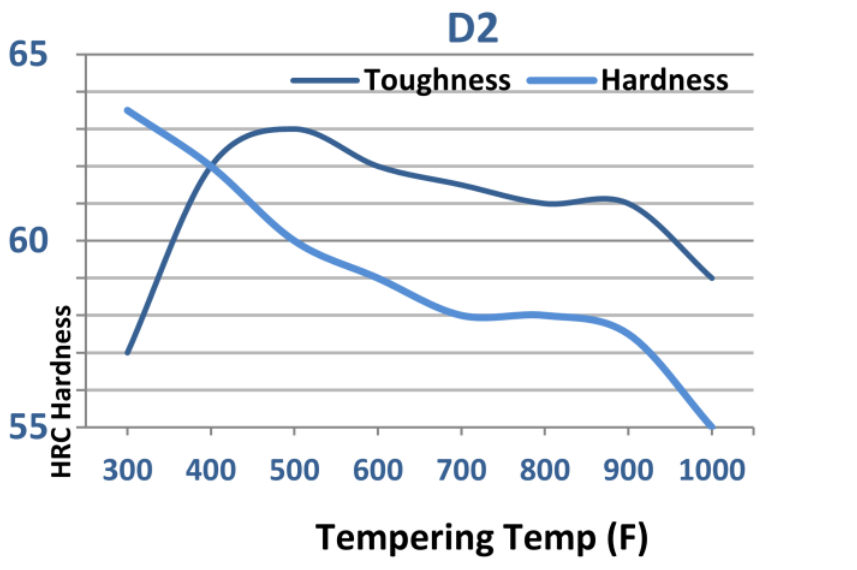
Temper: 400–1000°F (205–540°C). Temper 2 hours minimum each time or at least 1 hour per inch (25mm) of thickness, double temper. Cool to room temperature in between
tempers.
Cryogenic Treating: Refrigeration after the first temper may improve long term dimensions stability by transforming retained austenite. Any refrigeration treatment must be followed by a temper.
Size Change: (The amount of retained austenite has a significant effect.)
| Hardening Temperature | Tempering Temperature | HRC | Longitudinal Size Change |
|---|---|---|---|
| 1850°F (1010°C) | 400°F (205°C) | 61 | +0.025% |
| 1850°F (1010°C) | 600°F (315°C) | 59 | -0.010% |
| 1850°F (1010°C) | 800°F (425°C) | 58 | -0.017% |
| 1850°F (1010°C) | 1000°F (540°C) | 55 | -0.006% |
| Heat Treat Response - Hardness and Impact Toughness Data | |||
|---|---|---|---|
| Austenitized 1850°F (1010°C) Air Cool | |||
| Tempering Temperature |
HRC | Charpy C-Notch | |
| Ft-lbs | Joules | ||
| As Quenched | 63 | ||
| 300°F (150°C) | 62 | 17 | 23 |
| 400°F (205°C) | 61 | 21 | 29 |
| 500°F (260°C) | 60 | 23 | 31 |
| 600°F (315°C) | 59 | 22 | 30 |
| 700°F (370°C) | 58 | 22 | 30 |
| 800°F (420°C) | 58 | 21 | 29 |
| 900°F (480°C) | 58 | 21 | 29 |
| 1000°F (540°C) | 55 | 19 | 26 |
Welding
Use air hardening tool steel filler material.
Annealed Material: Preheat 700–900°F (370–485°C), maintain the temperature of the work piece at 700°F (370°C) minimum during welding. Reanneal after welding or temper at 1425°F (775°C) for 6 hours.
Hardened Material: Preheat 25–50°F (15–30°C) below original tempering temperature or 350°F (175°F) minimum. Maintain the temperature of the work piece at 350°F (175°F) minimum during welding. Cool to below 150°F (65°C) after welding. Temper 25°F (15°C) below original tempering temperature or 350°F (175°C) minimum.
This data sheet is for informational purposes only. Alloy characteristics are subject to change due to chemical composition and/or processing. We do not certify the material’s suitability for specific applications.